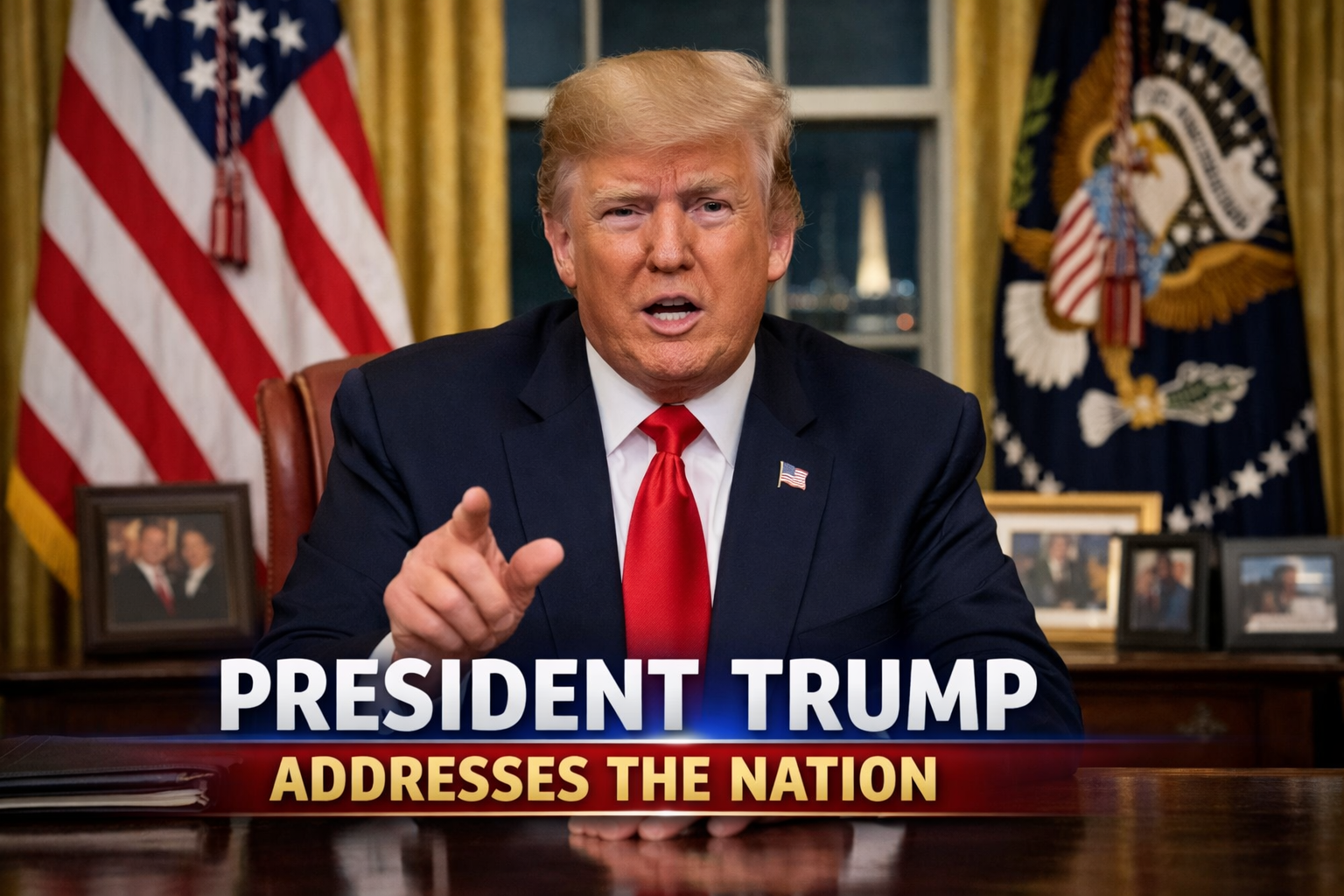
Washington, D.C. — President Donald Trump delivered a nationally televised address to the American people from the White House, seeking to reassure the nation amid mounting economic uncertainty, political polarization, and rising global tensions. The prime-time speech came as Americans face concerns over inflation, slowing job growth, and intensified debate over U.S. domestic and foreign policy priorities.
The address marked one of Trump’s most consequential speeches since returning to office, with the president outlining his administration’s economic strategy, defending recent policy decisions, and drawing sharp contrasts with Democratic leadership.
Economic Concerns Take Center Stage
President Trump opened his address by acknowledging the financial stress felt by many American families, citing higher living costs, housing affordability issues, and uneven job growth. However, he insisted that the U.S. economy is “stabilizing and positioned for a strong rebound” heading into 2026.
The president highlighted what he described as progress in controlling inflation and restoring market confidence, while blaming lingering economic challenges on policies enacted under the previous administration. Trump argued that deregulation, trade enforcement, and tariff revenue have helped strengthen federal finances and domestic manufacturing.
He emphasized that his administration is focused on:
-
Reducing energy costs through expanded domestic production
-
Supporting American manufacturing and supply chains
-
Protecting U.S. jobs from foreign competition
-
Restraining government spending
Despite recent labor market data showing slower hiring and revised job losses in prior months, Trump maintained that economic growth would accelerate in the coming year.
Announcement of “Warrior Dividend” for U.S. Military
One of the most notable moments of the address was Trump’s announcement of a one-time “warrior dividend” payment for active-duty U.S. military personnel.
According to the president, eligible service members will receive a $1,776 bonus, a symbolic figure referencing America’s founding year. The payments are expected to be distributed before Christmas and will be funded through tariff-related revenue, according to the administration.
Trump framed the move as a show of gratitude toward the armed forces, stating that the U.S. military has been “overused, underappreciated, and politically exploited” in recent years.
Sharp Political Tone and Blame on Democrats
Throughout the speech, President Trump adopted a distinctly partisan tone, placing responsibility for economic difficulties, border challenges, and rising healthcare costs on Democratic lawmakers and former President Joe Biden.
He criticized Democratic spending policies, immigration reforms, and environmental regulations, arguing they weakened economic stability and national security. Trump called on Congress to support stricter border enforcement, expanded deportation authority, and increased funding for law enforcement agencies.
The president also accused political opponents of deliberately undermining public confidence in the economy and institutions, portraying his administration as a corrective force restoring “law, order, and prosperity.”
Immigration and Border Security Emphasized
Immigration featured prominently in the address, with Trump reaffirming his commitment to hardline border policies. He defended expanded enforcement actions, limits on asylum access, and increased deportations as necessary steps to protect American workers and national security.
Trump urged Congress to pass legislation supporting border wall funding, faster removals, and broader executive authority over immigration enforcement, warning that failure to act would worsen economic and social pressures.
Foreign Policy and National Security Briefly Addressed
While the speech focused primarily on domestic issues, President Trump also touched on foreign policy, referencing recent U.S. military actions in the Pacific and reaffirming America’s commitment to defending its interests abroad.
He emphasized that the United States would maintain a strong military posture while avoiding what he described as “endless wars,” a recurring theme of his political messaging. The president did not provide extensive details on ongoing diplomatic negotiations but stressed that American strength remains the foundation of global stability.
Mixed Reactions Across the Political Spectrum
Reaction to the national address was swift and divided.
Republican lawmakers praised the speech as a necessary show of leadership, applauding the military bonus announcement and Trump’s focus on economic nationalism. Conservative commentators described the address as reassuring to voters concerned about inflation and job security.
Democrats, however, criticized the speech as misleading and overly partisan. Several lawmakers accused the president of exaggerating economic progress and ignoring structural issues such as wage stagnation, healthcare access, and housing shortages. Fact-checking organizations also disputed several claims related to inflation trends and tariff funding.
Broader Context and Political Implications
The address comes at a critical moment for the Trump administration, as approval ratings remain closely tied to public perceptions of economic performance. Polls indicate that while many Americans support stricter border enforcement, concerns about the cost of living remain the dominant issue for voters.
Political analysts view the speech as a strategic effort to reset the narrative, energize Trump’s political base, and position the administration ahead of key legislative battles and the upcoming election cycle.
Conclusion
President Trump’s national address underscored the deep divisions shaping American politics while highlighting the administration’s core message: economic nationalism, military strength, and aggressive governance. Whether the speech succeeds in restoring public confidence will depend largely on economic outcomes in the months ahead.
For now, the address signals that President Trump intends to double down on his governing approach, even as political tensions and economic uncertainty continue to define the national landscape.