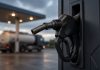
NEW YORK — American drivers are once again facing rising fuel costs as escalating tensions surrounding Iran send global oil prices sharply higher, fueling fears of another energy-driven inflation shock across the United States.
Oil markets have been rattled for weeks by growing instability in the Middle East, particularly around the Strait of Hormuz — one of the world’s most critical oil shipping routes. Analysts warn that prolonged disruptions could push gasoline prices even higher heading into the busy summer travel season.
Brent crude, the international benchmark for oil prices, recently climbed above $107 per barrel, while U.S. crude prices also surged amid fears that supply disruptions could worsen if the conflict expands.
For millions of Americans, the impact is already becoming visible at gas stations nationwide.
Gas prices climb across the United States
The national average gasoline price has risen rapidly in recent weeks, with several states now seeing prices above $4.50 per gallon. California has recorded some of the highest prices in the country, with certain stations approaching $7 per gallon.
Energy analysts say the sharp increase is being driven by several factors at once:
- fears of reduced Middle East oil exports,
- higher shipping and insurance costs,
- refinery disruptions,
- and seasonal demand ahead of summer travel.
The Strait of Hormuz remains at the center of market concerns because roughly one-fifth of the world’s oil supply normally passes through the narrow waterway. Any military escalation or shipping restrictions there can quickly trigger panic in global energy markets.
Although the United States is now one of the world’s largest oil producers, Americans are still heavily affected by global crude prices because oil is traded internationally.
“When global oil prices surge, U.S. consumers almost always feel it at the pump,” analysts say.
Why the Iran crisis matters to American households
Rising gasoline prices are not just about filling up cars. Higher oil prices ripple through nearly every part of the economy.
Transportation companies pay more for diesel. Airlines face rising jet fuel costs. Farmers spend more on fuel and fertilizer. Shipping expenses increase for retailers and manufacturers. Those added costs often end up being passed on to consumers.
Economists warn that prolonged energy inflation could raise prices for:
- groceries,
- airline tickets,
- online deliveries,
- construction materials,
- and household goods.
The Iran crisis has already contributed to broader inflation concerns in the U.S., with energy prices becoming one of the biggest drivers of recent consumer price increases.
Morgan Stanley analysts estimate that every major oil shock can significantly increase inflation pressure within a few months, especially if crude prices remain elevated for a long period.
Americans feel pressure despite strong economy
Despite rising costs, consumer spending in the United States has so far remained relatively resilient.
Retail sales and restaurant spending have continued to grow, helped partly by credit card usage and savings accumulated by higher-income households. However, economists say lower-income Americans are increasingly feeling squeezed as fuel and transportation consume a larger share of monthly budgets.
“This kind of energy shock acts like an extra tax on consumers,” one economist said.
The burden tends to hit rural families and commuters especially hard because they rely more heavily on driving long distances.
Farmers across the Midwest are also facing mounting pressure as diesel and fertilizer prices rise during planting season. Agricultural groups warn that higher production costs could eventually translate into more expensive food prices nationwide.
Airlines and travel industry under pressure
The travel industry is another major sector being affected by higher oil prices.
Jet fuel costs have surged alongside crude prices, raising concerns that airline ticket prices may continue climbing through summer. Some analysts estimate airlines have already absorbed billions of dollars in additional fuel expenses since the conflict intensified.
Travel demand remains strong, but prolonged high fuel prices could eventually force airlines to cut routes or raise fares further.
Americans planning summer vacations may therefore face:
- more expensive flights,
- higher rental car prices,
- and rising hotel transportation costs.
Political pressure builds in Washington
The surge in gas prices is also becoming a political issue in Washington ahead of the U.S. midterm election season.
President Donald Trump recently proposed temporarily suspending the federal gas tax in an effort to ease pressure on consumers. The proposal quickly gained support from several Republican lawmakers, although critics argued the savings for drivers could be limited.
The White House is also closely monitoring global oil supply conditions and could consider additional measures if prices continue rising sharply.
Potential options include:
- releasing oil from the Strategic Petroleum Reserve,
- diplomatic pressure on oil-producing allies,
- or encouraging increased domestic production.
However, analysts say global energy markets remain extremely sensitive to developments in the Middle East.
Markets fear prolonged instability
Many economists believe uncertainty itself is becoming one of the biggest economic risks.
Businesses can often adapt to stable high prices, but sudden volatility creates planning difficulties for industries ranging from manufacturing to logistics. Companies may delay investment, reduce hiring or conserve cash if oil markets remain unstable.
Some forecasts suggest oil could remain elevated through much of 2026 if tensions in the Middle East persist or if shipping disruptions continue in the Strait of Hormuz.
For now, Americans are likely to continue seeing higher fuel prices compared with earlier this year, with economists warning that the broader economic effects may extend far beyond the gas pump.
“The biggest question now is not whether prices rise,” one market analyst said. “It’s how long the instability lasts.”
What Could Happen Next?
- Gas prices could rise further if the Iran crisis disrupts oil shipments through the Strait of Hormuz.
- The White House may consider emergency steps such as releasing oil reserves or pushing for more domestic production.
- Airlines, trucking companies and food suppliers may pass higher fuel costs on to consumers.
- Inflation fears could grow if crude oil remains elevated for several weeks or months.
- Markets will closely watch whether the conflict expands or diplomatic talks reduce pressure on oil supplies.