Key Points
- Iran says it has received an official US response to its seven-day plan to reopen the Strait of Hormuz, delivered through Qatari mediators; its contents have not been made public.
- An official briefed on the talks told Reuters the two sides now differ mainly on the order of the steps, not on what the steps are.
- President Donald Trump publicly rejected the plan on Sept. 26 and on Monday denied reports that he had offered Iran sanctions relief, writing: “I offered them NOTHING.”
- Oil flows through the strait have recovered to nearly 80% of prewar levels, according to Kpler data cited by Al Jazeera, but ships are still being struck.
Iran has received an official US response to its seven-day proposal to reopen the Strait of Hormuz, days after President Donald Trump publicly rejected the plan. Neither side has said what the reply contains. However, the exchange shows that talks on the Iran US response Hormuz plan are still alive through Qatari mediators, even as ships in the waterway keep coming under fire.
The key question now is less whether the two sides talk than in what order each would act. That dispute over sequencing is shaping the next phase of a war now in its eighth month.
What Iran has received
Foreign Minister Abbas Araghchi received US feedback from Qatari mediators in Doha on Tuesday, Sept. 29, on his way home from the UN General Assembly, an official briefed on the talks told Reuters. The official said the mediators passed on feedback they had received from Washington on Monday.
On Wednesday, Araghchi presented the US response to President Masoud Pezeshkian at a Cabinet meeting, government spokesperson Fatemeh Mohajerani told the state-run IRNA news agency, according to the Associated Press. Iranian officials did not say what the response contained or whether it amounted to a rejection.
“We will make every effort to bring the agreement to fruition and will firmly stand up for the rights of the Iranian people,” Pezeshkian said, according to AP. “The agreement must now be based on a win-win strategy.”
Where the two sides differ
According to the official who spoke to Reuters, the document being discussed sets out a seven-day period of trust-building. Its aim is to return both sides to an enhanced version of the memorandum of understanding they reached in June, including concrete steps on Iran’s nuclear program. The disagreement centers on the sequencing of those steps rather than their components, the official said.
Iran’s original offer, presented in New York during the UN General Assembly, asked Washington to lift its naval blockade of Iranian ports, waive oil sanctions and release frozen Iranian funds. In return, Araghchi said, the strait could reopen and normal shipping resume within seven days, followed by talks on a final deal.
Qatar says it is still working to narrow the gap. “We are exchanging messages between the parties, and we’re working towards establishing a common ground in order to get into a deal that would save all of us from the repercussions of the conflict,” Qatari Foreign Ministry spokesperson Majed al-Ansari told reporters on Tuesday, Reuters reported.
Trump’s public line
Trump rejected the plan on the record on Saturday, Sept. 26, saying Iran wanted a deal because it was “losing so badly” but that its offer “would not be acceptable,” AP reported.
On Monday night, he denied reports by Axios and CNN, citing unnamed US officials, that he was willing to give Iran sanctions relief and release frozen funds if Tehran showed “concrete progress” on the nuclear issue. “This is untrue. I offered them NOTHING,” he wrote on Truth Social, according to Reuters.
Speaking to reporters on Tuesday, Trump said: “I don’t know if they are going to give up yet but they’ll give up. They are doing very poorly.” He also predicted again that the war would be “over with very, very soon,” AP reported. More recently, he has said he expects the war will not end until after the Nov. 3 midterm elections.
Pressure keeps building on both sides
Washington has kept up its economic campaign, which it calls “Operation Economic Outcast.” On Tuesday, the Treasury Department sanctioned 10 people and entities in Iran, Hong Kong and Pakistan that it accuses of procuring weapons and weapon components for Iran’s defense ministry, AP reported. Iran’s currency also hit a record low that day, trading at more than 2.5 million rials to the dollar in Tehran.
Tehran has not dropped its threats either. Revolutionary Guard spokesperson Hossein Mohebbi said on Wednesday that there is an ongoing “military conflict” in the strait. “We have been hitting small ships and preventing them from passing for a long time, but America does not respond,” he told the semi-official Fars news agency, according to Al Jazeera. The UK Maritime Trade Operations centre said unknown projectiles struck three ships in the waterway on Tuesday, including a crude oil tanker.
Why the strait matters now
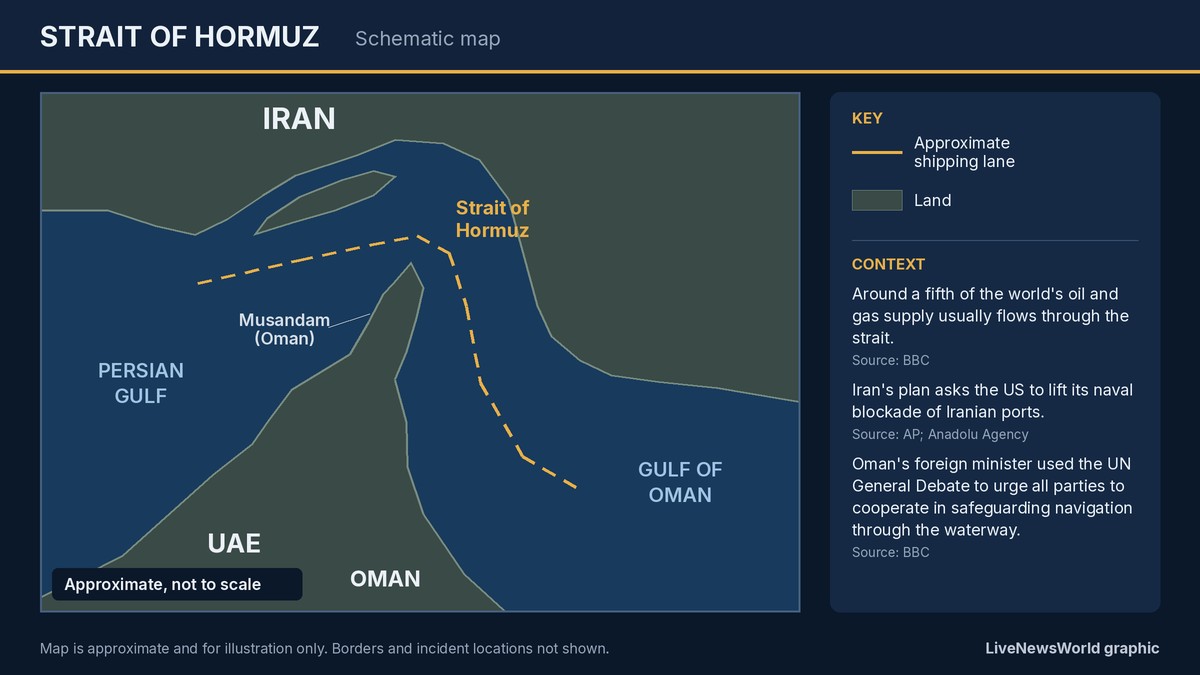
Around a fifth of the world’s oil and gas usually passed through the Strait of Hormuz before the war, which began on Feb. 28 with US and Israeli attacks on Iran. Traffic has since recovered sharply. Commodity analytics firm Kpler estimates Middle East crude exports have climbed back to just under 80% of their prewar level, with Hormuz flows expected at about 9.7 million barrels per day in September, Al Jazeera reported. Analysts told Al Jazeera that the recovery could weaken Iran’s leverage, although tanker insurance costs remain high.
Oil prices reflect that mix. Brent crude fell 2.6% to $102.59 a barrel on Tuesday as traders focused on recovering Middle East exports, Al Jazeera reported, but it was still on course for a gain of about 13% in September. The standoff over the waterway has repeatedly shaped this year’s diplomacy, from Iran’s April offer to reopen the strait if the US lifted its blockade to Trump’s review of an earlier Iranian peace plan.
What happens next
The next marker is Tehran’s formal answer to the US feedback, and whether Qatar can bridge the dispute over which side moves first. Until the terms of the US response are made public, neither a ceasefire nor a reopening timetable has been agreed. For now, the strait stays at the center of both the fighting and the talks.