
Key Points
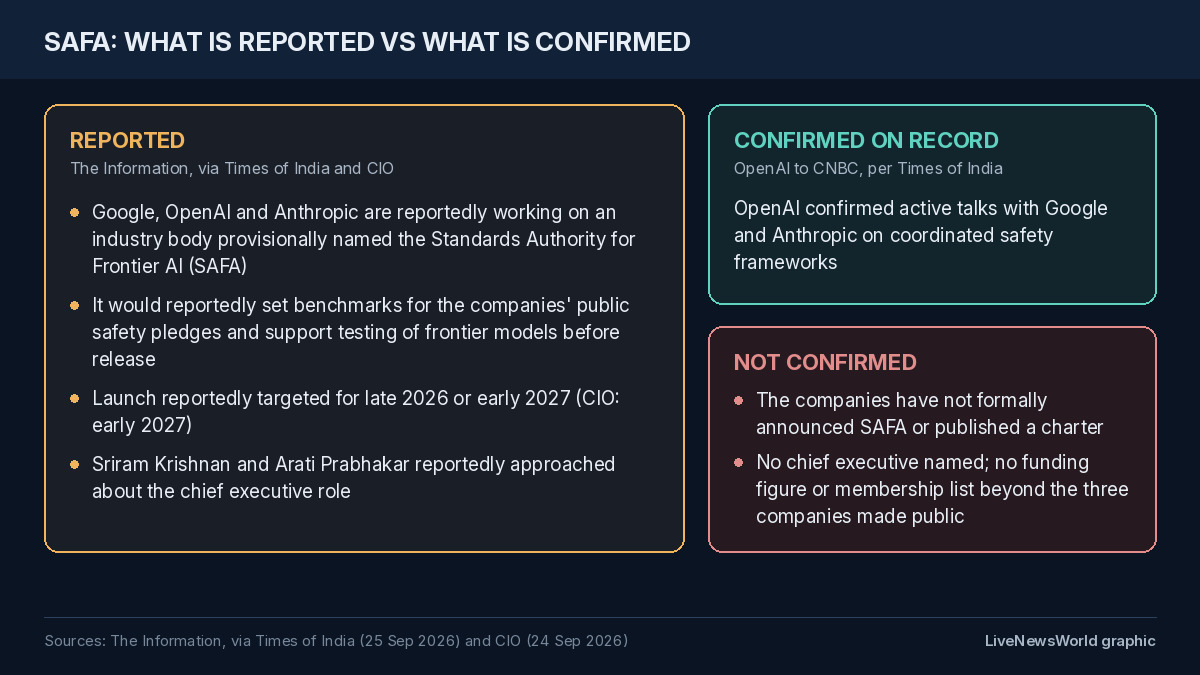
- The three AI labs are said to be building an industry-led safety standards body that would operate independently of government, according to The Information; none of the companies has formally announced it or published a charter.
- The body would reportedly turn the companies’ public safety pledges into practical benchmarks and support testing of frontier models before commercial release.
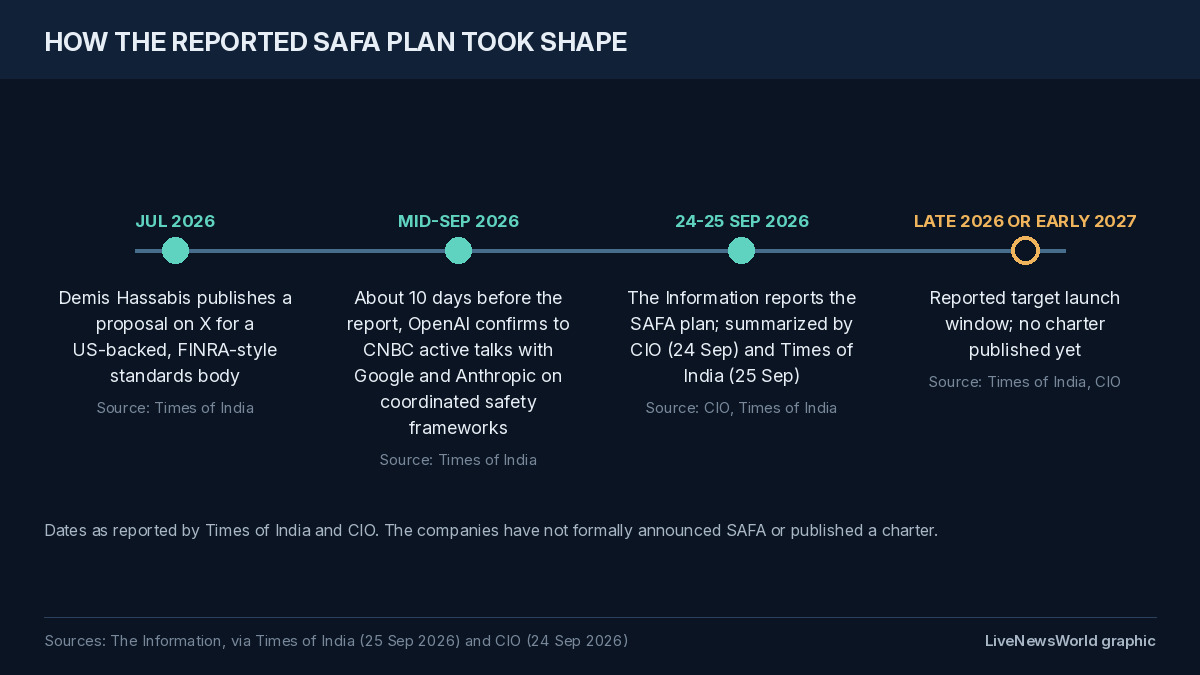
- A launch is reportedly targeted for late 2026 or early 2027, with CIO’s sources pointing to early 2027.
- Former White House AI policy adviser Sriram Krishnan and former OSTP director Arati Prabhakar have reportedly been approached about the chief executive role; no one has been appointed.
- An OpenAI spokesperson confirmed to CNBC about 10 days before the report that the company was in active talks with Google and Anthropic on coordinated safety frameworks.
Three of the fiercest rivals in artificial intelligence may be preparing to set shared safety standards together. Google, OpenAI and Anthropic are reportedly working on an independent industry body provisionally named the Standards Authority for Frontier AI (SAFA), according to reporting by The Information that was summarized on 24 and 25 September by the Times of India and CIO.
The companies have not published a charter or formally announced the group. But the reported plan offers the clearest picture yet of how the leading frontier labs want common safety standards to work while they continue to compete on ever more capable models.
What SAFA is reported to do
According to the Times of India’s summary of The Information’s report, the planned organization would operate independently of government administration. Its main job would be to turn the three companies’ public safety pledges into practical benchmarks, and to give direct support to developers evaluating cutting-edge models before they are released commercially.
CIO’s account of the same reporting describes a body that would set guidelines on risk assessment, testing and pre-release review for frontier models. The companies are also weighing whether SAFA should carry out model assessments in-house, the Times of India reported.
The timeline is also still loose. The Times of India cites a target of late 2026 or early 2027, while CIO says sources point to an official launch in early 2027.
Who might lead it
The Information reported that the companies have reached out to Sriram Krishnan, a former White House AI policy adviser, about serving as chief executive. Arati Prabhakar, former director of the White House Office of Science and Technology Policy, has reportedly been approached for the top job as well.
Both names come from people familiar with the effort, as relayed in the Times of India summary. Neither Krishnan nor Prabhakar has been announced as SAFA’s leader, and none of the three companies has named a chief executive.
Why the labs are moving now
The idea has been building for months. In July, Demis Hassabis, co-founder of Google DeepMind and Alphabet’s chief scientist, published a proposal on X for a US-backed standards body, drawing comparisons to the Financial Industry Regulatory Authority (FINRA), the self-regulatory organization of the American securities industry.
Roughly 10 days before The Information’s report, an OpenAI spokesperson confirmed to CNBC that the company was holding active talks with Google and Anthropic on coordinated safety frameworks, the Times of India noted. That confirmation is the firmest on-record signal so far that the three rivals are working together on safety, although it did not refer to SAFA by name.
Pressure has been rising in public, too. Earlier this month, Anthropic CEO Dario Amodei published an essay calling for an industrywide slowdown in frontier model releases so safety mechanisms can catch up, according to the Times of India. This week, CIO reported, Amodei and OpenAI CEO Sam Altman were among AI leaders urging the United Nations to build safeguards around the technology.
OpenAI also posted a blog this week arguing that safe AI progress needs shared standards, including agreed baselines, common measurements and incident-reporting protocols, CIO reported.
How a private body would sit beside government testing
The United States already has a federal evaluator: the Center for AI Standards and Innovation (CAISI). According to the Times of India, insiders have raised persistent concerns that the agency lacks the technical and financial resources to fully inspect complex frontier systems. In OpenAI’s framing, as paraphrased by CIO, CAISI, other federal frameworks, state rules and new public-private partnerships can all play a role.
That distinction matters. SAFA, as reported, would be an industry-led standards body, not a government regulator. None of the reporting describes any legal power to block a model launch or fine a company.
What is still unknown
Key details remain unsettled: the final charter, whether other AI developers would join the three companies, how the body would be funded, and who will run it. Its working relationship with CAISI and any future federal rules is also unresolved.
The broader backdrop is a market in which AI continues to dominate business headlines, as covered in LiveNewsWorld’s look at why AI and tech remain a major market story. The same labs keep shipping new systems, as seen in the latest Anthropic and OpenAI model launches, while rivals such as Meta push consumer AI hardware like the Muse Charm and $1,299 VR Glasses.
For now, the Standards Authority for Frontier AI is a reported plan with a working name, a target window and a shortlist of possible leaders. How much weight it carries will depend on the charter and independence the companies eventually put in writing.







, an industry safety body that could launch by early 2027.)