Key Points
- On Sept. 16, 2026, Google opened early access to Home MCP so third-party AI agents can read Nest and Matter home state and control connected devices.
- Compatible agents cited in coverage include Claude, ChatGPT, Hermes, OpenClaw, and Google Antigravity.
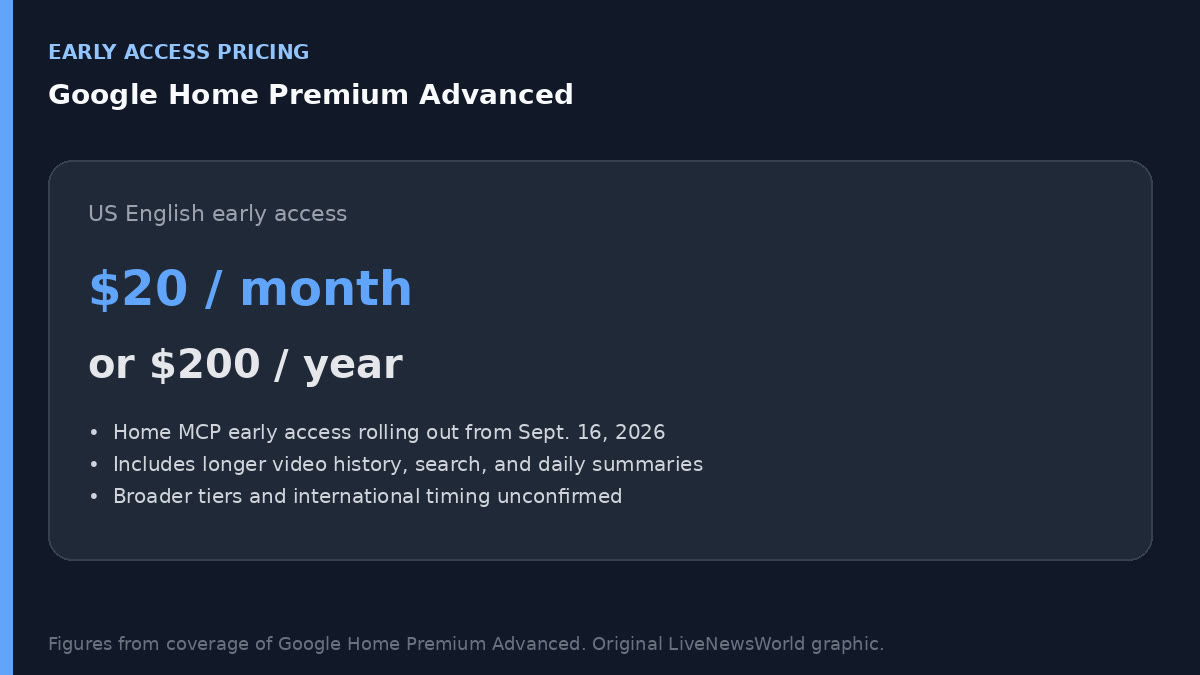
- Early access is limited to Google Home Premium Advanced subscribers in US English at $20 per month or $200 per year.
- Google says unlocking doors is prohibited and rate limits apply; Home MCP does not replace Gemini for Home.
Google is inviting third-party AI agents into the Nest living room. On Sept. 16, 2026, the company began rolling out early access to Google Home AI agent MCP, a Home Model Context Protocol server that lets compatible agents read home state and history and control connected devices with natural language.
For searchers asking how Home MCP works, who can use it, and what privacy tradeoffs come with agentic control, the short answer is this: Premium Advanced subscribers in US English can wire Claude, ChatGPT, and other MCP-capable agents into Google Home through a Google Cloud project and OAuth consent. Agents can summarize cameras, toggle Matter lights, and build custom dashboards. They are not allowed to unlock doors, and Google still positions Gemini for Home as its own assistant layer.
Key numbers at a glance
| Measure | Detail |
|---|---|
| Early access start | Sept. 16, 2026 (rolling over coming weeks) |
| Premium Advanced monthly | $20 |
| Premium Advanced annual | $200 |
| Language / market at launch | US English |
| MCP endpoint cited in coverage | home.googleapis.com/mcp |
| Sensitive action blocked (Google) | Door unlocking |
What Google Home MCP actually does
Home MCP is Google’s consumer-facing MCP endpoint for the smart home. Coverage cites the server at home.googleapis.com/mcp. Anthropic introduced the Model Context Protocol in 2024 as a way for agents to call external tools and data sources; Google already uses MCP elsewhere in Cloud, developer tools, and Workspace. Home MCP brings that pattern to Nest and Matter devices people already own.
Taylor Lehman, group product manager at Google Home & Nest, described the pitch in reporting that quotes Google’s announcement: agents that support MCP, including Google Antigravity, Claude, Hermes, or OpenClaw, can “securely work with all of the devices and event history in your Google Home ecosystem.” TechCrunch also lists ChatGPT among agents that can connect.
In practice, that means everyday language instead of app hopping. Reported examples include cross-camera summaries (what happened when the kids got home), device-history questions (how many laundry loads, how long lights stayed on), voice messages pushed to a Google Home speaker when an agent finishes a task, and custom dashboards built to the household’s taste.
Supported hardware spans the Google Home ecosystem: Nest cameras, doorbells, and thermostats, plus Matter and “Works with Google Home” products such as bulbs. For broader AI platform context on LiveNewsWorld, see AI and tech as a major market story.
Who gets early access, and what it costs
Access is not free or universal. Google is rolling Home MCP to Google Home Premium Advanced subscribers in US English, starting Sept. 16, 2026, and continuing over the coming weeks. That tier is priced at $20 per month or $200 per year. Premium Advanced already packages longer event-based video history, descriptive notifications, video search, and daily summaries; MCP is an additional early-access capability on that plan.
Google would not say when (or whether) Home MCP will reach other subscription tiers or markets outside US English. International timing and any official blog.google URL were not independently confirmed for this package and should not be invented at publish time. Whether agents can create new automations at launch is likewise unconfirmed in primary coverage.
| Item | Status at announcement |
|---|---|
| Who gets it | Premium Advanced, US English early access |
| Device scope | Nest cams / doorbells / thermostats; Matter & Works with Google Home |
| Example agents | Claude, Hermes, OpenClaw, ChatGPT, Google Antigravity |
| Setup path | Google Cloud project, Home MCP config, OAuth permissions |
| Gemini for Home | Remains Google’s Home app / Nest speaker interface; not replaced |
| Broader rollout | Google would not comment |
How setup works
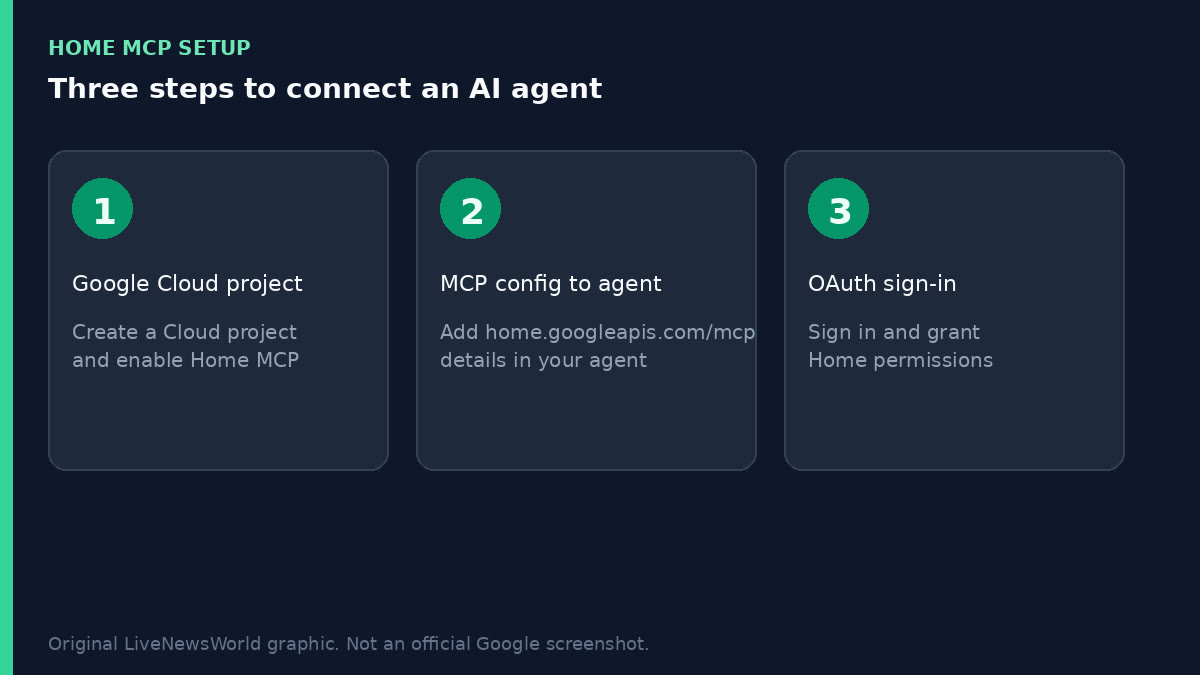
Setup is developer-adjacent, even for consumers. Reporting describes three moves:
- Create a Google Cloud project and enable Home MCP.
- Pass the MCP configuration to the chosen agent and ask it to finish setup.
- Sign in and grant permissions through OAuth.
Google points complete guides to the Google Home Developer Center. The friction is intentional: connecting an agent to cameras and climate controls is not a one-tap widget. Additional reporting is available from 9to5Google and The Verge.
Privacy, safety, and what MCP does not replace
Agentic control is the product story and the risk story. Giving a third-party model a live window into doorbell clips, thermostat schedules, and light patterns expands the trust boundary beyond Google’s own assistant. Google says Home MCP enforces rate limits and safety protections, including a hard ban on sensitive actions such as unlocking doors.
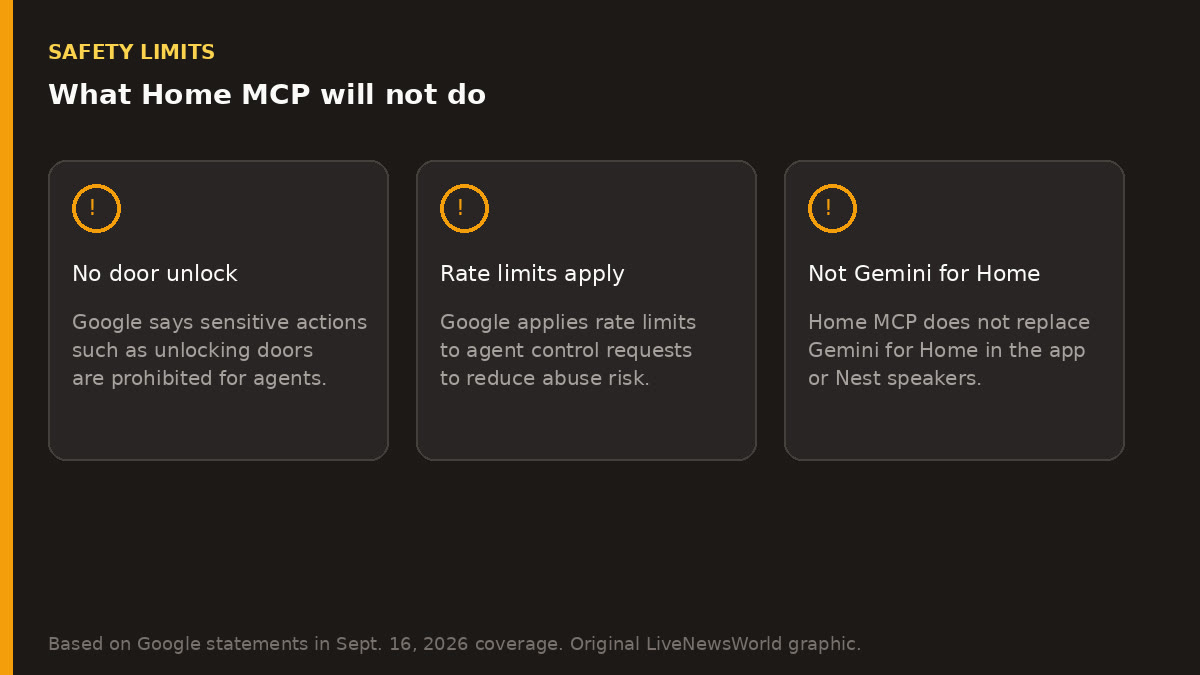
Lehman also warns, in language carried by Verge and 9to5Google, that depending on the agent, connecting to Home MCP can produce unexpected or undesired behavior. Users are told to review developer policies and terms of service before linking accounts.
Equally important for readers comparing assistants: Home MCP does not replace Gemini for Home. Gemini for Home remains Google’s interface in the Home app and on Nest speakers after the Google Assistant transition. MCP is a parallel control layer so outside agents can act on the same device graph through their own chat UIs. Speakers may still deliver agent voice messages, but the Nest “brain” Google ships to households stays Gemini for Home.
This draft does not allege a Google Home breach. Industry debate about MCP authentication hygiene exists in secondary commentary, but there is no confirmed incident tied to this Home MCP launch in the sources used here. Editors should keep any security discussion attributed and product-specific. Engadget also covered the agentic Home integration.
Why the launch matters
Smart homes have long been command-and-control systems: say a phrase, flip a switch. Home MCP pushes Google Home toward agentic context: an external model that can reason across history, summarize multi-room video, and act without the user opening every app. It also deepens Google’s bet on being the infrastructure layer underneath other consumer AI brands, as long as those brands speak MCP and users stay inside Google Home Premium Advanced. Related LiveNewsWorld reading includes future technologies framing and broader agentic AI adoption context.
For now, the practical checklist is narrow. If you already pay for Premium Advanced in the United States, speak English in that product surface, and are comfortable granting an agent OAuth access to Nest and Matter gear, early access is starting. If you need door unlocks automated by an AI, Google says no. If you expected Gemini for Home to disappear, it does not. And if you live outside US English or on a cheaper Home plan, the wait continues until Google says otherwise.