Key Points
- U.S. Treasury auctions are public sales of bills, notes, bonds, TIPS, and floating-rate notes that finance the federal government.
- Treasury uses single-price auctions: noncompetitive bids are accepted first, then competitive bids from lowest to highest yield until the offering is filled.
- All successful bidders receive the same stop-out (high) yield. Noncompetitive bids are capped at $10 million per auction; competitive awards are capped at 35% of the offering.
- Auction results help set the coupon and price of new Treasuries and feed into the broader yield curve that markets compare with the federal funds rate.
U.S. Treasury auctions are the public sales where the federal government issues marketable securities (bills, notes, bonds, TIPS, and floating-rate notes) to investors. Each auction announces a security and a size, collects bids, and awards the issue at a single stop-out yield so that every successful bidder pays the same price for that auction. Understanding Treasury auctions matters because those results are the birth certificate of new government debt and a key input into the yield curve that prices everything from mortgages to corporate bonds.
This explainer covers the four-step process, competitive versus noncompetitive bidding, the main tenors, how the high yield is set, and how auction results connect to Fed policy and the yield curve. For related LiveNewsWorld explainers, see the inverted yield curve, the federal funds rate, and what the U.S. Federal Reserve does.
What is a Treasury auction?
When the United States needs to borrow, the Treasury Department sells marketable securities that investors can hold to maturity or trade in the secondary market. Those securities are backed by the full faith and credit of the U.S. government. The primary sale happens at auction. Secondary trading happens afterward among investors, dealers, and funds.
TreasuryDirect, the Bureau of the Fiscal Service’s investor site, describes auctions in four steps: announce the auction, hold the auction, bid for the amount you want, and issue the securities. Announcements list the security, the offering amount, auction and issue dates, maturity, terms, and separate closing times for noncompetitive and competitive bids. Upcoming announcements are updated on a regular schedule (TreasuryDirect notes Friday updates by 10:45 a.m. Eastern for the upcoming list).
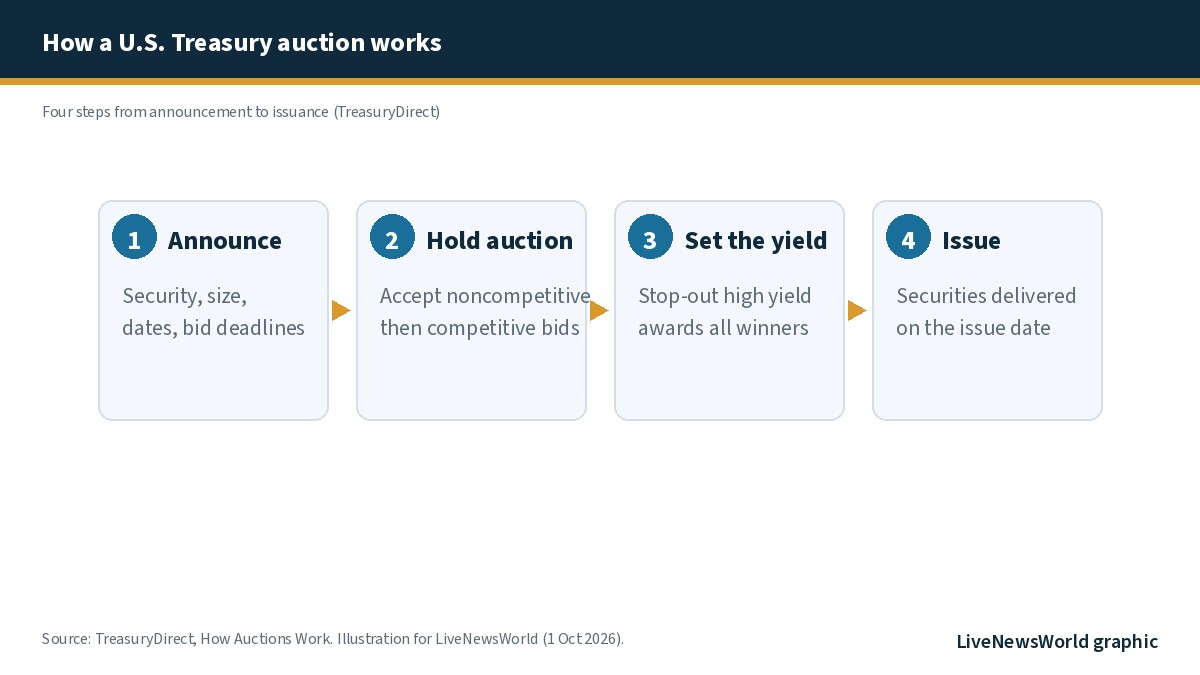
Four times a year, usually on the first Wednesday in February, May, August, and November, Treasury holds a quarterly refunding press conference and typically publishes a tentative auction schedule for the next six months. That calendar is the backbone of bill, note, and bond supply that markets price in advance.
Competitive vs noncompetitive bids
Anyone can participate in a Treasury auction, but the bid type changes what you must specify and how much you can buy.
Noncompetitive bids do not name a yield. You state the amount you want (up to $10 million per auction) and agree to accept the rate, yield, or discount margin determined at the auction. TreasuryDirect accounts bid only noncompetitively. Most individual investors use this route because it guarantees the full amount of a qualifying bid at the auction-determined return.
Competitive bids name the return you require: a discount rate for bills, a yield for notes, bonds, and TIPS, or a discount margin for floating-rate notes. Competitive bids are submitted through a bank, broker, or dealer (or through institutional systems such as Treasury’s Debt Financing System). Awards to a single competitive bidder are limited to 35% of the offering amount (subject to net long position rules in the Uniform Offering Circular).
You may bid noncompetitively or competitively in a given auction, but not both ways in the same auction.
| Feature | Noncompetitive | Competitive |
|---|---|---|
| What you specify | Amount only | Amount and desired yield / rate / margin |
| Maximum | $10 million per auction | 35% of offering amount |
| Typical bidder | Individuals via TreasuryDirect or brokers | Dealers, funds, institutions via brokers/banks |
| Award certainty | Full amount if rules are met | Full, partial, or none, depending on the stop-out |
| Price received | Same stop-out price as other winners | Same stop-out price as other winners |
Source: TreasuryDirect, How Auctions Work and Auction FAQs. Fetched 1 Oct 2026.
How the stop-out yield is set
Modern Treasury marketable auctions use a single-price (uniform-price) format. Treasury has used that technique for all marketable securities auctions since November 1998, according to TreasuryDirect’s additional auction FAQs.
After bidding closes, Treasury first accepts all valid noncompetitive bids. It then accepts competitive bids from the lowest yield (or discount rate or discount margin) upward until the offering amount is filled. The highest accepted yield needed to complete the sale is the stop-out, also called the high yield. Every successful competitive bidder and every noncompetitive bidder is awarded securities at the price that corresponds to that high yield.
If bids piled up exactly at the stop-out exceed the remaining supply, Treasury prorates awards at that yield. The published allocation percentage tells bidders what share of their stop-out bids was filled. Bids that demanded a higher yield than the stop-out receive nothing.
That design has two practical effects. First, you do not need to “guess exactly right” as a noncompetitive bidder; you take the market-clearing return. Second, competitive bidders who bid too greedily (too high a yield) risk being shut out, which disciplines the auction and helps produce a transparent clearing level.
Bills, notes, bonds, TIPS, and FRNs
Treasury marketable securities differ mainly by maturity and how interest is paid. All of the types below are sold at auction (cash management bills are a special short-term bill sold irregularly and not through TreasuryDirect).
| Security | Typical terms | Interest / return | Auction rhythm (overview) |
|---|---|---|---|
| Treasury bills | 4, 6, 8, 13, 17, 26, and 52 weeks | Sold at discount or par; interest is the difference to face value at maturity | Weekly for most short bills; every four weeks for 52-week bills |
| Treasury notes | 2, 3, 5, 7, and 10 years | Fixed coupon paid every six months | 2/3/5/7-year monthly; 10-year in Feb/May/Aug/Nov (plus reopenings) |
| Treasury bonds | 20 and 30 years | Fixed coupon paid every six months | Original issues several times a year, plus reopenings |
| TIPS | 5, 10, and 30 years | Fixed real rate; principal adjusts with CPI | Scheduled original issues and reopenings through the year |
| Floating Rate Notes | 2 years | Coupon resets based on indexed bills; bid as a discount margin | Original issues Jan/Apr/Jul/Oct; reopenings other months |
Source: TreasuryDirect pages for bills, notes, bonds, and TIPS. Minimum purchase is generally $100 in $100 increments. Fetched 1 Oct 2026. Always check the current auction calendar for exact dates.
Minimum purchases are typically $100. Interest on Treasury marketable securities is subject to federal income tax but exempt from state and local income taxes, per TreasuryDirect’s product pages.
Recent auction high yields in context
Auction results publish the high yield, bid-to-cover ratio (total tendered divided by total accepted), and allocation at the high yield. Those metrics tell you where demand cleared and how aggressive bidding was at the margin.
Using U.S. Treasury Fiscal Data auction records fetched on 1 Oct 2026, the most recent 2-year note auction in the sample (22 Sep 2026) stopped at a high yield of 4.787% with a bid-to-cover ratio of 2.63. The most recent 10-year note original-cycle auction in the filtered nominal sample (12 Aug 2026) stopped at 4.683% with a bid-to-cover of 2.53. (TIPS auctions, which clear at real yields, are excluded from the chart below by a yield filter so the lines compare nominal notes.)
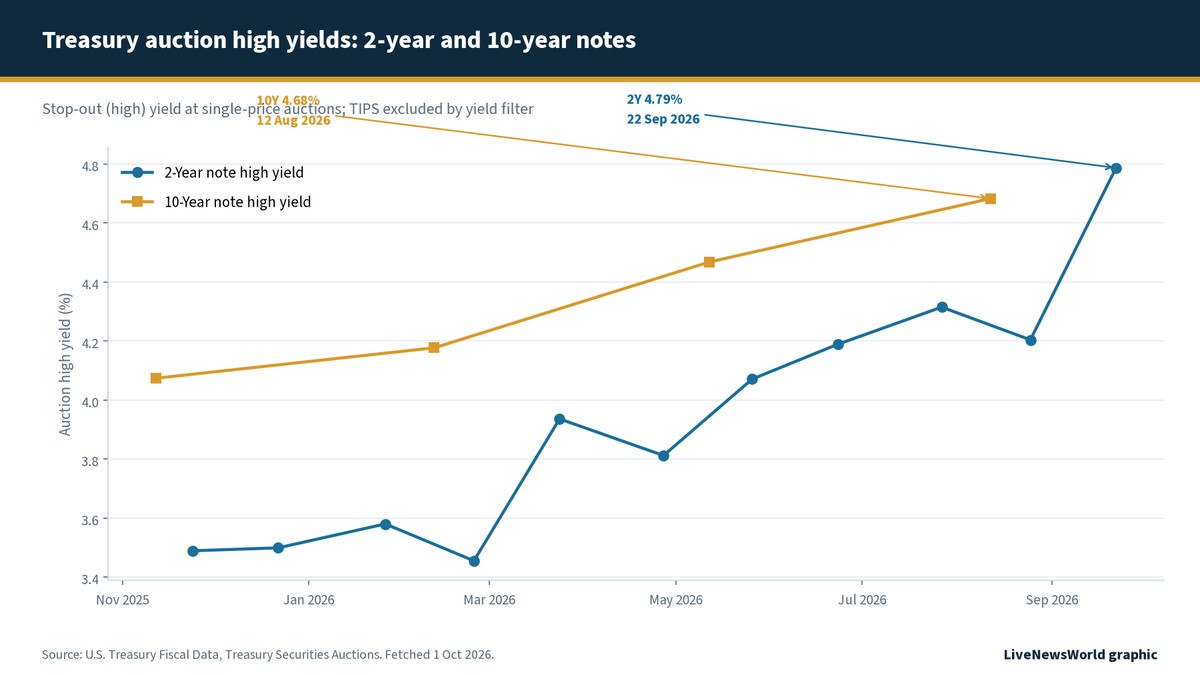
Those stop-out yields become the reference for the new issue’s coupon and price. After issuance, the security trades in the secondary market, and its yield can move above or below the auction level as news and Fed expectations change. Auction tails (the gap between the stop-out and when-issued yields) and soft bid-to-cover ratios are watched as signs of demand stress, but one auction rarely rewrites the entire curve.
How Treasury auctions connect to the Fed and the yield curve
Treasury sets debt management and the auction calendar. The Federal Reserve sets the stance of monetary policy, notably through the federal funds rate target range and balance-sheet operations. The two are institutionally separate, but they meet in markets: Fed policy shapes short-term rates and the expected path of policy, while Treasury supply and auction clearing levels help pin down yields across maturities.
The yield curve plots yields by maturity. When short-term yields sit above long-term yields, the curve is inverted, a pattern markets watch as a recession signal (see LiveNewsWorld’s inverted yield curve explainer). Auction results for 2-year and 10-year notes are among the building blocks of that curve. A string of weak 10-year auctions can push long yields higher if dealers demand more compensation to absorb supply. Strong demand can do the opposite.
None of that means the Fed “controls” the 10-year auction. Policy expectations, inflation outlook, global savings, and Treasury’s issuance size all matter. Auction literacy simply helps you read one of the cleanest public windows into how the government borrows and how investors price that debt.
Auction calendar basics for readers
Bill auctions are frequent. Most short-term bills are weekly; the 52-week bill follows a four-week rhythm. Note and bond auctions follow the quarterly refunding pattern plus monthly coupon issues for intermediate notes. Reopenings sell more of an existing CUSIP instead of creating a brand-new security, which can improve liquidity in that issue.
Practical tips:
- Watch TreasuryDirect’s upcoming announcements and results pages, or Fiscal Data’s auctions dataset, rather than relying on social-media summaries.
- Note the separate closing times for noncompetitive and competitive bids on each announcement.
- Remember that the auction date and the issue date are often days apart; payment and delivery happen on the issue date.
- If you buy through TreasuryDirect, results for your bid are available in the account after the auction (TreasuryDirect cites after 5 p.m. Eastern on auction day for account views).
For the official walkthrough of the process, see TreasuryDirect: How Auctions Work.
Common misconceptions about Treasury auctions
“The bidder who offers the most money sets the yield.” In a yield auction, competitive bidders who accept the lowest yields (are willing to lend more cheaply) are accepted first. The clearing level is the highest yield still needed to sell the full offering.
“Noncompetitive bidders get a worse price.” In today’s single-price design, noncompetitive and successful competitive bidders receive the same stop-out price.
“Auction yields are the same thing as the federal funds rate.” The funds rate is an overnight interbank policy rate. Auction yields are term rates on specific Treasuries. They are related through markets and expectations, not identical.
“A bid-to-cover above 1.0 always means a ‘strong’ auction.” Bid-to-cover is one clue, not a full grade. Dealers look at the tail versus when-issued levels, direct and indirect bidder shares, and whether the stop-out cheapened relative to fair value.
Frequently asked questions
What is the difference between a Treasury auction and buying Treasuries in the secondary market?
An auction is the primary sale of a new (or reopened) security from the Treasury. The secondary market is trading among investors after issuance. Secondary prices move continuously; auction prices are set at the stop-out for that offering.
Can individuals bid in Treasury auctions?
Yes. Individuals typically bid noncompetitively through TreasuryDirect or through a bank or broker, up to $10 million per auction. Competitive bidding for larger, yield-specified orders generally requires a broker, dealer, or institutional channel.
What does “single-price auction” mean?
It means every successful bidder pays the price that corresponds to the highest accepted competitive yield (the stop-out). Treasury does not charge different winners different prices based on their individual bids in the modern format.
How do Treasury auctions affect mortgage rates?
Mortgage rates track longer-term yields and mortgage-backed securities more than any single auction. Still, note and bond auction results influence the Treasury curve that mortgage markets use as a benchmark. A sustained rise in 10-year auction yields often accompanies higher mortgage quotes, all else equal.
The bottom line
Treasury auctions are how the United States issues marketable public debt in the open market. Noncompetitive bids take the clearing yield; competitive bids help discover it. Single-price awards, published calendars, and transparent results make the process readable for households and professionals alike. Watch the stop-out yield, the bid-to-cover, and how those levels sit on the broader curve, and you will understand the plumbing behind the bond market headlines.