Key Points
- The federal funds rate is the interest rate U.S. banks charge each other for overnight loans of reserve balances held at Federal Reserve Banks.
- The Federal Open Market Committee sets a target range for that rate. As of Sept. 17, 2026, the range is 3.75% to 4.00%, according to the Federal Reserve Board.
- The effective federal funds rate, the volume-weighted average of actual overnight trades, was 3.88% on Sept. 24, 2026, per the Federal Reserve Bank of New York.
- Changes in that overnight rate ripple into credit cards, auto loans, mortgages, savings yields and business borrowing, though each channel moves at a different speed.
The federal funds rate is the overnight interest rate that banks charge one another when they lend reserve balances. It is the Federal Reserve’s main policy lever for steering short-term borrowing costs across the U.S. economy. When the Fed raises or lowers its target for that rate, the effects eventually show up in credit-card APRs, auto loans, home equity lines, business credit and many savings yields, and they also influence longer-term rates that help set mortgage quotes.
This guide explains how the rate is set, how the Fed keeps the market print inside its target range, how policy reaches everyday borrowing and saving, and how to read the latest official figures without treating every Fed headline as a personal finance emergency.
What is the federal funds rate?
Every day, banks and other depository institutions hold reserve balances in accounts at Federal Reserve Banks. Some institutions end the day with more reserves than they want. Others need more. They borrow and lend those balances overnight in the federal funds market. The interest rate on those overnight loans is the market rate the Fed targets.
The Federal Open Market Committee (FOMC), the Fed’s main monetary policy body, does not dictate a single transaction rate for every trade. Instead it announces a target range. The New York Fed’s trading desk and the Board’s administered rates then keep the market’s average overnight rate, called the effective federal funds rate (EFFR), inside that range. For a broader look at the institution behind the policy, see our explainer on what the U.S. Federal Reserve does and why it matters.
Two numbers matter when you read a Fed decision:
- Target range: the band the FOMC wants, currently expressed in quarter-point steps (for example, 3.75% to 4.00%).
- Effective federal funds rate: the volume-weighted median of actual overnight trades, published each business day by the Federal Reserve Bank of New York.
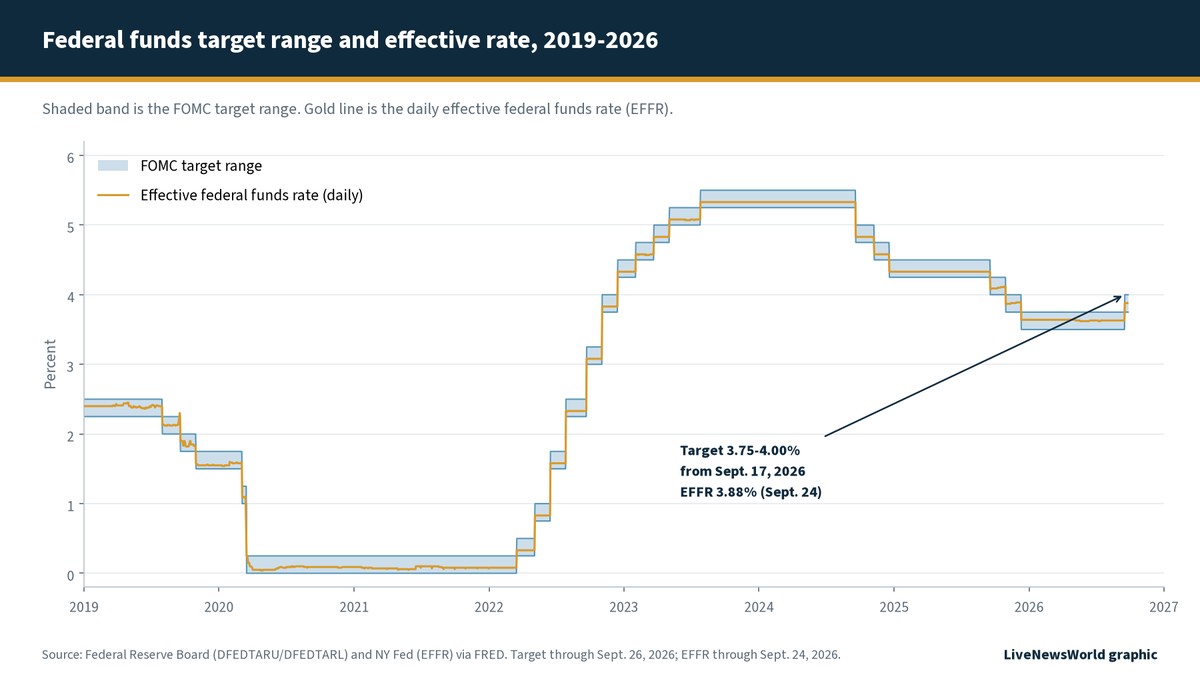
The chart below shows how the target range and the effective rate have moved together since 2019, including the near-zero years, the 2022-23 hiking cycle, the 2024-25 cuts, and the Sept. 2026 adjustment.
Where the rate stands today
On Sept. 16, 2026, the FOMC raised its target range by 25 basis points to 3-3/4 to 4 percent (3.75% to 4.00%), effective Sept. 17, 2026. The decision is recorded on the Federal Reserve Board’s open market operations page and in the FOMC’s Sept. 16, 2026 statement.
According to New York Fed reference-rate data compiled by FRED, the effective federal funds rate was 3.88% on Sept. 24, 2026, inside the new target range. The interest rate on reserve balances (IORB), the main administered rate that helps pin overnight funding, was set at 3.90% effective Sept. 17, 2026.
| Measure | Level | As of | Source |
|---|---|---|---|
| FOMC target range | 3.75% to 4.00% | Effective Sept. 17, 2026 | Federal Reserve Board (DFEDTARL / DFEDTARU) |
| Effective federal funds rate | 3.88% | Sept. 24, 2026 | NY Fed via FRED (EFFR) |
| Interest on reserve balances | 3.90% | Effective Sept. 17, 2026 | Federal Reserve Board via FRED (IORB) |
| Monthly average (FEDFUNDS) | 3.63% | August 2026 | Federal Reserve Board via FRED |
Figures fetched from FRED and Federal Reserve publications on Sept. 27, 2026 (PKT). The monthly FEDFUNDS series lags the daily EFFR and still reflects the prior 3.50% to 3.75% target month.
How the Fed keeps the rate in its target range
Before 2008, the Fed mainly steered overnight funding by changing the supply of reserves through open market operations. Today the system runs with ample reserves. The Fed relies more on administered rates than on day-to-day reserve scarcity.
Interest on reserve balances
Banks earn interest on the reserve balances they keep at the Fed. That interest on reserve balances (IORB) rate acts as a reservation rate: a bank has little reason to lend reserves overnight to another bank for less than it can earn risk-free at the Fed. IORB is the primary tool for keeping overnight funding near the top of the target range.
Overnight reverse repurchase facility
The overnight reverse repo (ON RRP) facility lets a broader set of counterparties, including money market funds, park cash overnight with the Fed at a set offering rate. That rate helps put a floor under overnight market rates when non-bank cash would otherwise push the funds rate lower.
Discount window and standing repo
The primary credit rate at the discount window, and the standing overnight repurchase facility, sit at or near the top of the range. They give banks a backstop source of liquidity so they do not have to bid the funds rate far above the target.
Together, these tools keep the effective rate inside the FOMC’s band on most days without the Fed needing to drain or add large amounts of reserves each afternoon.
How the federal funds rate affects you
Households and small businesses rarely borrow in the federal funds market. The rate still reaches them because banks, credit-card networks, auto lenders and bond investors price off short-term funding costs and policy expectations. The table below summarizes the main transmission channels.
| What you feel | How Fed policy feeds in | Typical speed |
|---|---|---|
| Credit cards and HELOCs | Many variable APRs are tied to the prime rate, which banks set a fixed spread above the federal funds target. | Weeks after a Fed move |
| Auto loans and personal loans | Lenders fund loans with short- and medium-term borrowing; higher policy rates raise their cost of funds. | Weeks to a few months |
| Adjustable-rate mortgages | Resets follow short-term indexes that move with Fed policy. | At each reset date |
| Fixed-rate mortgages | Priced off longer-term Treasury and mortgage-backed yields, which reflect expected future Fed paths more than today’s overnight rate alone. | Markets can move before the Fed acts |
| Savings accounts, CDs, money market funds | Deposit and money-fund yields compete with overnight rates banks and funds can earn; higher policy rates usually lift savings yields, with banks often slower to raise them than to raise loan rates. | Weeks to months |
| Business loans and hiring | Higher short-term rates raise the cost of working capital and can cool investment and hiring when demand softens. | Months (economy-wide lag) |
Transmission description based on Federal Reserve explanations of the monetary policy interest-rate channel. Individual product rates also reflect credit risk, competition and term premiums.
That lag is why Fed decisions are about the outlook for inflation and employment, not about next week’s grocery bill. Inflation measures such as the CPI and the PCE price index help the Fed judge whether policy is tight enough; our guide to CPI vs PCE explains how those two gauges differ. Job-market reports show the other side of the dual mandate; see how to follow U.S. job market reports.
A short history of policy-rate milestones
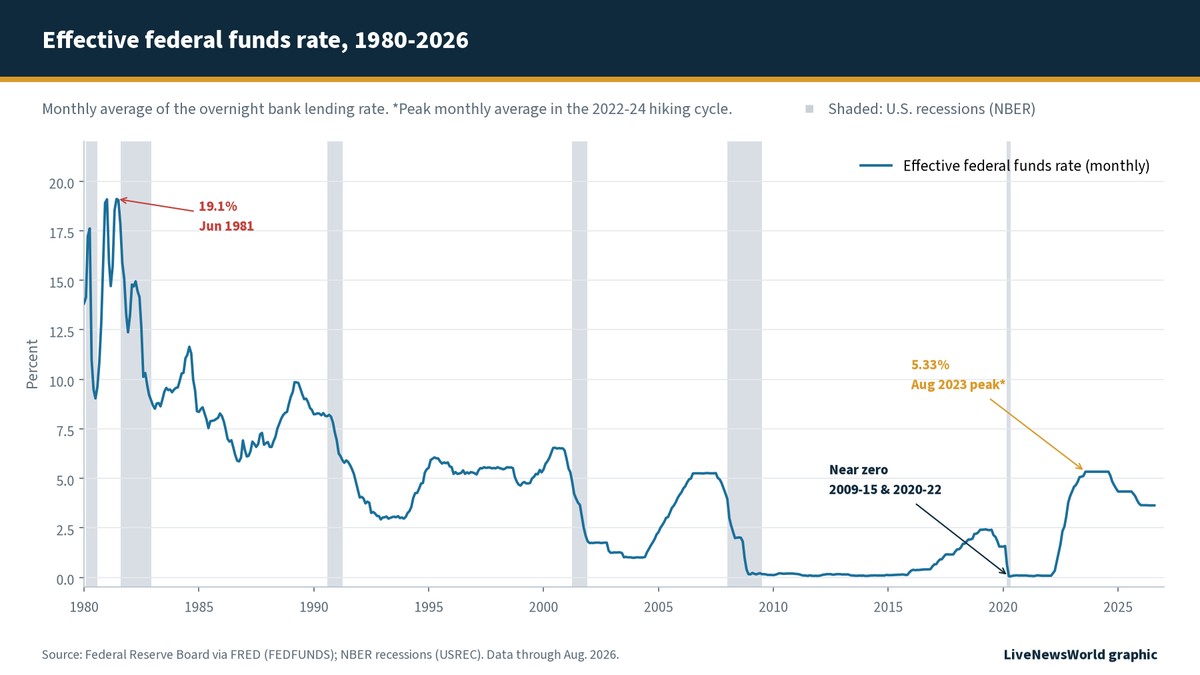
The monthly effective federal funds rate has swung from nearly 20% in the early 1980s inflation fight to near zero after the 2008 financial crisis and again in 2020. The chart below plots that monthly average since 1980, with U.S. recessions shaded.
Selected target-range milestones from Federal Reserve Board data (FRED series DFEDTARU and DFEDTARL) help place today’s setting in recent context:
| Effective date | Target range | What changed |
|---|---|---|
| March 16, 2020 | 0.00% to 0.25% | Emergency cut to the floor at the start of the pandemic |
| March 17, 2022 | 0.25% to 0.50% | First hike of the inflation-fighting cycle |
| July 27, 2023 | 5.25% to 5.50% | Cycle peak target range (held until Sept. 2024) |
| Sept. 19, 2024 | 4.75% to 5.00% | First cut after the peak |
| Dec. 11, 2025 | 3.50% to 3.75% | Low point of the subsequent easing stretch |
| Sept. 17, 2026 | 3.75% to 4.00% | 25 basis-point increase; current range |
Source: Federal Reserve Board via FRED (DFEDTARL, DFEDTARU) and the Board’s open market operations historical table. Monthly effective rate peak in the 2022-24 cycle: 5.33% in August 2023 (FRED FEDFUNDS).
When the Fed lifts short-term rates quickly, the short end of the Treasury curve often rises faster than long-term yields. That pattern can invert the yield curve, a signal markets watch for recession risk. Our companion explainer on the inverted yield curve walks through that relationship in more detail.
What a rate hike or cut usually means
A higher policy rate tends to cool demand: borrowing costs rise, interest-sensitive spending slows, and inflation pressure eases over time if the tightening sticks. A lower rate tends to do the opposite: credit gets cheaper, asset prices often firm, and demand can reaccelerate.
Those are tendencies, not switches. Financial conditions also depend on bank lending standards, fiscal policy, oil prices, the dollar and global demand. A single 25 basis-point move rarely transforms household budgets overnight. What matters more is the path of policy over many meetings and how that path reshapes expectations for inflation and growth.
Video: how the Fed steers interest rates
This Wall Street Journal explainer shows how the Fed uses its modern toolkit to guide overnight rates and, through them, the broader economy.
Frequently asked questions
Is the federal funds rate the same as the prime rate?
No. The federal funds rate is the overnight interbank rate the Fed targets. The prime rate is a benchmark many banks publish for consumer and business loans. Banks typically set prime a fixed spread (often three percentage points) above the top of the federal funds target range, so prime moves when the Fed moves, but the two rates are not identical.
Why does the Fed use a range instead of a single number?
Since December 2008 the FOMC has expressed its federal funds objective as a range, usually 25 basis points wide. That reflects how policy is implemented with administered rates and ample reserves: the tools are designed to keep the effective rate inside a band rather than pin every trade to one exact print.
Does a higher policy rate automatically raise my mortgage rate?
Not automatically. Fixed mortgage rates track longer-term yields and mortgage-backed securities more closely than today’s overnight rate. Those longer yields embed expectations about where the Fed will be years ahead, plus term premiums. Adjustable-rate mortgages and home equity lines, by contrast, usually reprice more directly with short-term rates.
Where can I check the latest effective federal funds rate?
The Federal Reserve Bank of New York publishes the EFFR each business morning. The Federal Reserve Board’s open market operations page lists the current FOMC target range and the historical record of changes. FRED series EFFR, DFEDTARU, DFEDTARL and FEDFUNDS provide downloadable history.
The bottom line
The federal funds rate is the overnight price of bank reserves, and the Fed’s target for that rate is the starting point for short-term interest rates across the United States. As of mid-September 2026 the FOMC’s target range is 3.75% to 4.00%, and the effective rate has been trading inside that band. For households, the practical question is not the overnight print itself but how the Fed’s path feeds into credit cards, loans, mortgages and savings over the following months. Watch the target range, the effective rate, and the inflation and jobs data that drive the next decision, rather than any single meeting in isolation.