Key Points
- Quantitative tightening is the Federal Reserve shrinking its securities holdings mainly by letting Treasuries and agency mortgage-backed securities mature without fully reinvesting the principal.
- The latest QT program ran from June 2022 until runoff ended on December 1, 2025, after the FOMC judged reserve balances had moved into an ample range; securities holdings fell by more than $2.2 trillion over that stretch (Fed Policy Normalization page).
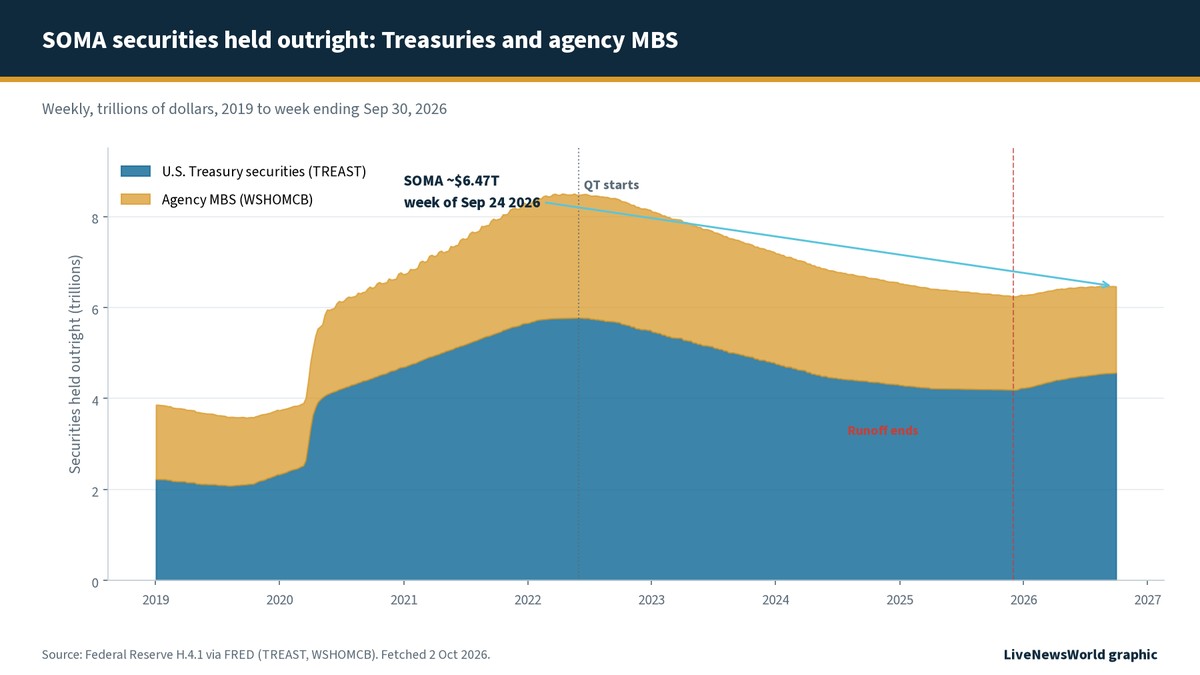
- As of the H.4.1 week ending September 23, 2026, SOMA securities held outright were about $6.47 trillion (Treasuries plus agency MBS via FRED TREAST and WSHOMCB).
- After runoff stopped, the New York Fed Desk used reserve management purchases of Treasury bills to keep reserves ample; from mid-August 2026 those RMPs were paused while agency-MBS principal continued to be reinvested into bills.
Quantitative tightening is the Federal Reserve’s process of reducing its securities portfolio after large-scale asset purchases. In plain terms, it is the opposite of quantitative easing: instead of buying Treasuries and agency mortgage-backed securities to add bank reserves, the Fed lets holdings shrink so fewer reserves stay in the system over time. Markets watch it because it changes the supply of safe assets the Fed holds, the stock of reserves, and, at the margin, the backdrop for rates and risk appetite.
This explainer covers how quantitative tightening works as balance-sheet runoff, how monthly caps limited the pace, what changed when runoff ended in late 2025, and how markets still feel the after-effects. For related context, see LiveNewsWorld on the federal funds rate and what the U.S. Federal Reserve is.
What is quantitative tightening?
Quantitative tightening (QT) is a balance-sheet policy tool. During quantitative easing (QE), the Fed buys securities and credits reserves to banks. During quantitative tightening, the Fed does the reverse in a controlled way: it reduces securities held in the System Open Market Account (SOMA), which tends to reduce reserve balances over time as other Federal Reserve liabilities evolve.
The modern U.S. version of QT has been implemented mainly as runoff, not as large forced sales. When a Treasury security matures, the Fed can choose to reinvest the principal into new Treasuries or let some of that principal roll off. When agency mortgage-backed securities pay down through scheduled amortization and prepayments, the Fed can reinvest those proceeds or allow them to shrink holdings. Caps set a maximum monthly amount that can run off; principal above the cap is reinvested.
That design matters. Runoff is gradual and somewhat automatic. It still removes duration and reserves over time, which is why investors treat QT as a tightening of financial conditions even when the federal funds rate target is unchanged.
Quantitative tightening vs quantitative easing
QE and QT are balance-sheet cousins of ordinary interest-rate policy. Rate policy sets the overnight federal funds target range. Balance-sheet policy changes the stock of securities the Fed holds and the associated reserve liabilities. The two tools can move together, but they are not the same dial.
| Feature | Quantitative easing (QE) | Quantitative tightening (QT) |
|---|---|---|
| Direction | Fed buys securities; balance sheet grows | Fed shrinks securities holdings; balance sheet shrinks or stops growing |
| Typical method | Large-scale asset purchases | Capped runoff of maturing Treasuries and MBS paydowns |
| Reserves effect | Adds bank reserves | Tends to drain reserves over time |
| Market feel | Adds liquidity and demand for bonds | Removes a price-insensitive buyer; private markets absorb more supply |
| Not the same as | Cutting the federal funds rate | Raising the federal funds rate |
Conceptual comparison based on Federal Reserve Policy Normalization materials and the May 2022 Plans for Reducing the Size of the Federal Reserve’s Balance Sheet. Fetched 2 Oct 2026.
How runoff caps work
On May 4, 2022, the FOMC published plans to reduce securities holdings primarily by adjusting reinvestment of principal payments. Beginning June 1, 2022, principal payments would be reinvested only to the extent they exceeded monthly caps.
The initial caps were $30 billion per month for Treasury securities and $17.5 billion per month for agency debt and agency mortgage-backed securities. After three months, those caps rose to $60 billion and $35 billion, respectively. For Treasuries, the decline under the cap covered coupon maturities first, with bills used if coupon maturities were below the cap. For agency securities, principal above the cap was reinvested into agency MBS during the QT period under the original plans.
Caps are a speed limit, not a promise that the full amount will roll off every month. If maturities and paydowns are smaller than the cap, actual runoff is smaller. If they are larger, the excess is reinvested. That is why monthly QT can vary even when the published cap is unchanged.
The Committee also said it intended to slow and then stop the decline when reserve balances were somewhat above the level judged consistent with ample reserves. That sequencing is the bridge from QT to today’s reserve-management regime.
What the latest balance-sheet numbers show
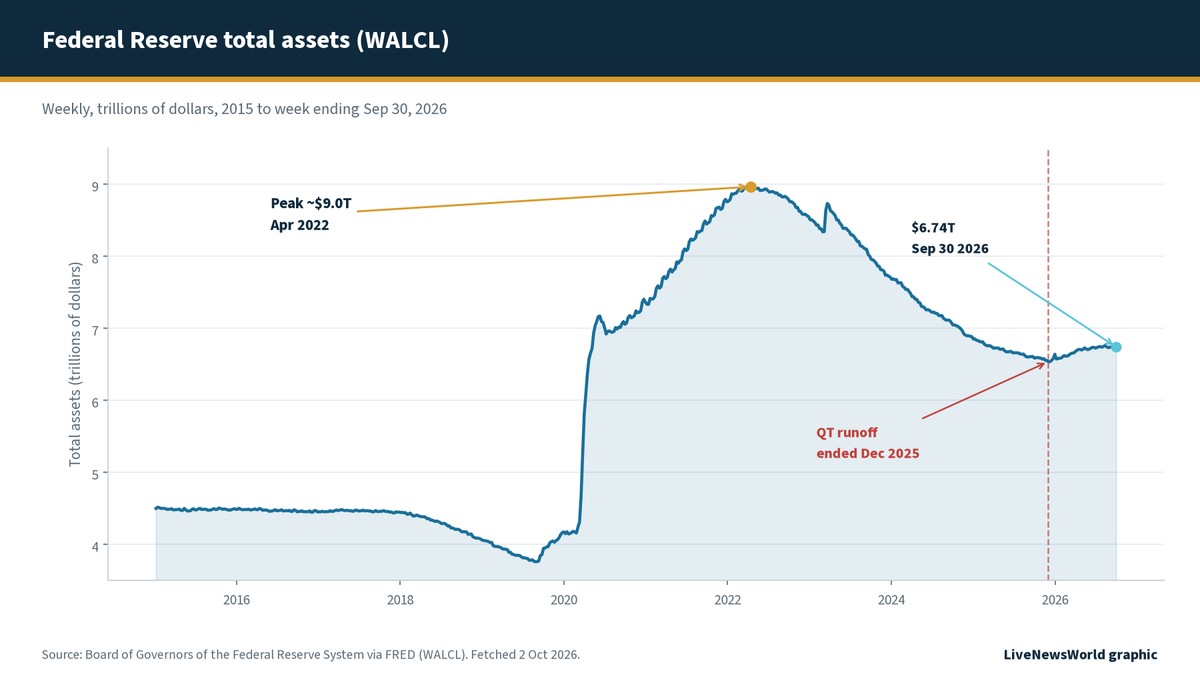
As of early October 2026, the latest complete weekly H.4.1 observations in FRED run through the week ending September 30, 2026. Securities held outright (U.S. Treasury securities plus agency mortgage-backed securities) were about $6.47 trillion for the week ending September 23, 2026, matching the familiar “about $6.47 trillion” reading around the week of September 24. Total Federal Reserve assets (WALCL) were about $6.74 trillion on September 30. Reserve balances (WRESBAL) were about $2.95 trillion that same week.
| Milestone (nearest weekly date) | SOMA Treasuries + MBS | Total assets (WALCL) | Reserve balances |
|---|---|---|---|
| Apr 13, 2022 (near QE peak) | $8.50 trillion | $8.97 trillion | $3.82 trillion |
| Jun 1, 2022 (QT start) | $8.48 trillion | $8.92 trillion | $3.32 trillion |
| Dec 3, 2025 (near runoff end) | $6.24 trillion | $6.54 trillion | $2.86 trillion |
| Sep 23, 2026 (week of Sep 24) | $6.47 trillion | $6.75 trillion | $2.93 trillion |
| Sep 30, 2026 (latest week) | $6.46 trillion | $6.74 trillion | $2.95 trillion |
Source: Federal Reserve H.4.1 via FRED series TREAST, WSHOMCB, WALCL, and WRESBAL. SOMA column is TREAST plus WSHOMCB. Figures rounded to two decimals in trillions. Fetched 2 Oct 2026.
The Fed’s Policy Normalization page summarizes the completed runoff as a decline of more than $2.2 trillion in total securities holdings, including about $1.6 trillion in Treasuries and $600 billion in agency MBS, with securities holdings as a share of nominal GDP falling from 33 percent to 20 percent over the QT period.
From runoff to reserve management purchases
On October 29, 2025, the FOMC announced it would cease the runoff of securities holdings starting December 1, 2025. The Desk was directed to roll over all principal payments from Treasury holdings at auction and to reinvest all principal payments from agency securities into Treasury bills. That stopped the active QT runoff phase.
In December 2025, after judging that reserves had declined to an ample range, the FOMC instructed the Desk to begin reserve management purchases (RMPs), primarily of Treasury bills, to keep reserves ample. RMPs grow the SOMA when needed for reserve management. They are not a return to crisis-era QE stimulus messaging; the New York Fed describes them as technical purchases sized to seasonal and trend reserve demand.
Through early 2026, monthly RMP amounts were adjusted as conditions changed. According to New York Fed operational details, RMPs were later reduced and then set to zero for the mid-August to mid-September 2026 period and again for mid-September to mid-October 2026, while reinvestment purchases of agency principal into bills continued (about $17.0 billion and $15.6 billion in those two monthly windows). NY Fed officials have stressed that RMP amounts are not on a preset course and can resume if reserve conditions tighten.
Composition can still shift when totals are roughly stable. Agency MBS holdings continue to pay down; those proceeds are reinvested into bills, so the portfolio gradually tilts toward shorter-term Treasuries.
How quantitative tightening affects markets
QT’s market channel is mostly about who holds the bonds and how scarce reserves become. When the Fed stops reinvesting, private investors, money funds, and banks must absorb more Treasury and mortgage supply. That can put upward pressure on term yields relative to a world where the Fed kept rolling everything. The effect is usually gradual, and it can be swamped by growth, inflation, and federal funds rate expectations.
Reserves are the other channel. In an ample-reserves regime, the Fed wants enough reserves in the system so that day-to-day funding markets clear smoothly near the administered rates that implement the federal funds target. If reserves fall too far, repo and federal funds rates can become more volatile. That is why the FOMC planned to stop QT before reserves became scarce, and why RMPs exist after runoff ends.
For households and businesses, QT rarely appears as a named line on a loan offer. It shows up indirectly through Treasury and mortgage-backed markets and the broader rate complex that feeds mortgages, auto loans, and corporate borrowing. LiveNewsWorld’s explainer on how U.S. Treasury auctions work covers where new government debt meets private demand. The inverted yield curve explainer covers another market signal that often moves with rate and growth expectations while QT is in the background.
How to read QT without confusing it with rate hikes
Start with the policy rate. The federal funds target range is still the primary tool for the stance of monetary policy, as the FOMC’s own principles emphasize. QT is a secondary, slower tool that adjusts the balance sheet.
Next, separate three states of the balance sheet: active runoff (QT), paused runoff with rollovers, and reserve management purchases. Saying “the Fed is doing QT” after December 1, 2025, is outdated for the U.S. program that just concluded. The more accurate early-2026 description is that runoff ended, agency paydowns are being swapped into bills, and RMPs are used when needed to keep reserves ample.
Finally, watch reserves and money-market conditions, not only the headline size of the balance sheet. Total assets can wobble with the Treasury General Account and other liabilities even when securities policy is steady. Securities held outright and reserve balances are the cleaner QT scoreboard.
Common misconceptions about quantitative tightening
“QT is just another name for raising interest rates.” No. Rate hikes change the overnight policy rate. QT changes the stock of securities and reserves. They often happen in the same cycle, but they are different instruments.
“QT means the Fed is selling all its bonds.” The 2022-2025 program was primarily capped runoff of maturing securities and MBS paydowns, not continuous large-scale sales.
“When the balance sheet stops shrinking, liquidity is permanently loose.” Ending runoff stops the active drain from QT. Other liabilities, seasonal tax flows, and private demand for reserves can still tighten money markets. That is why RMPs and standing facilities remain part of the toolkit.
“RMPs are secretly QE.” Both involve buying Treasuries, but the stated purpose, size, and communication differ. QE was used to ease broader financial conditions at scale. RMPs are framed as maintaining ample reserves for rate control. Readers should follow the FOMC’s own language rather than treating every purchase as stimulus.
Video: quantitative tightening explained
The Plain Bagel’s explainer walks through what quantitative tightening is and why markets care about balance-sheet runoff. Preview the embed before relying on it in a live post.
Video: “Quantitative Tightening Explained (and What it Means for Markets),” The Plain Bagel. Title and publisher verified via YouTube oEmbed on 2 Oct 2026.
Frequently asked questions
Is quantitative tightening still happening in 2026?
The FOMC ended the runoff of aggregate SOMA securities holdings effective December 1, 2025. Since then, the Desk has focused on maintaining ample reserves, including with bill purchases when appropriate, while continuing to reinvest agency principal into Treasury bills. That is not the same as the 2022-2025 QT runoff program.
Does quantitative tightening raise mortgage rates by itself?
QT can contribute at the margin by removing a large, steady buyer of duration, including agency MBS during runoff. Mortgage rates still depend heavily on longer-term Treasury yields, credit spreads, and expectations for the federal funds rate. Treat QT as one background factor, not the sole driver of any week’s mortgage quote.
Where can I track the Fed’s securities holdings?
The Federal Reserve’s weekly H.4.1 release is the official scoreboard. FRED republishes the main lines, including total assets (WALCL), Treasury holdings (TREAST), and agency MBS holdings (WSHOMCB). See FRED WALCL for total assets used in this article’s first chart.
The bottom line
Quantitative tightening is the Fed’s controlled reduction of securities holdings, implemented in 2022-2025 mainly through capped runoff rather than fire-sale bond dumps. That runoff ended on December 1, 2025, after reserves moved into an ample range. Today the relevant story is portfolio composition, bill reinvestment of agency paydowns, and occasional reserve management purchases to keep rate control smooth. Read QT as a balance-sheet chapter that sits beside, not instead of, the federal funds rate.