Key Points
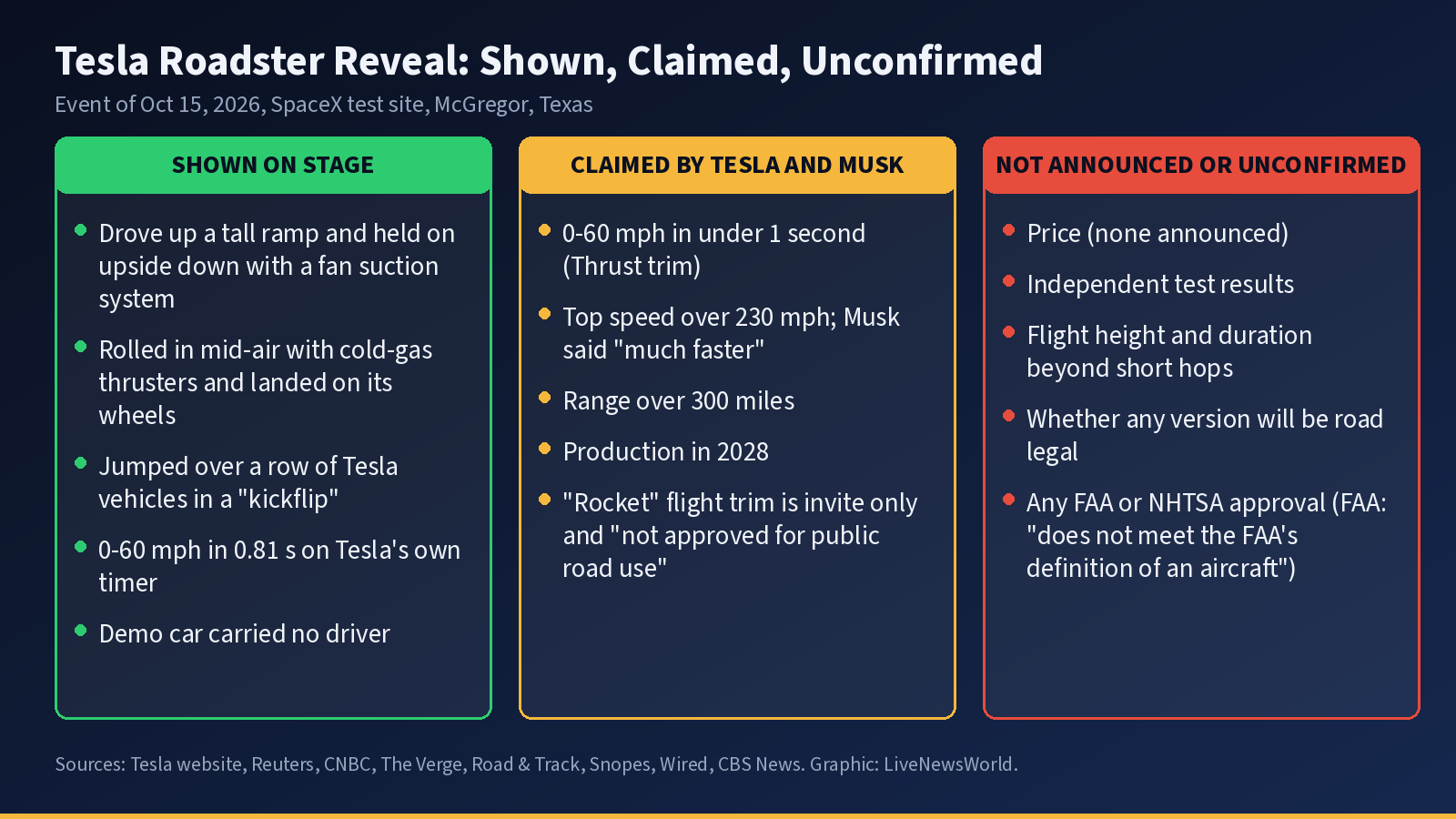
- Tesla unveiled its next-generation Roadster on Oct. 15 at a SpaceX test site in McGregor, Texas, where a prototype with no one aboard drove upside down on a ramp, rolled in mid-air and jumped over other Teslas using cold-gas thrusters.
- Elon Musk posted on X, “Turns out the future does have flying cars.” The flight-capable “Rocket” version is invite only, and Tesla’s own site says it is “not approved for public road use.”
- Tesla claims 0-60 mph in under one second, a top speed over 230 mph and range over 300 miles, with production in 2028. No price was announced.
- The FAA told Wired the vehicle “does not meet the FAA’s definition of an aircraft,” and the demos were short hops, not sustained flight.
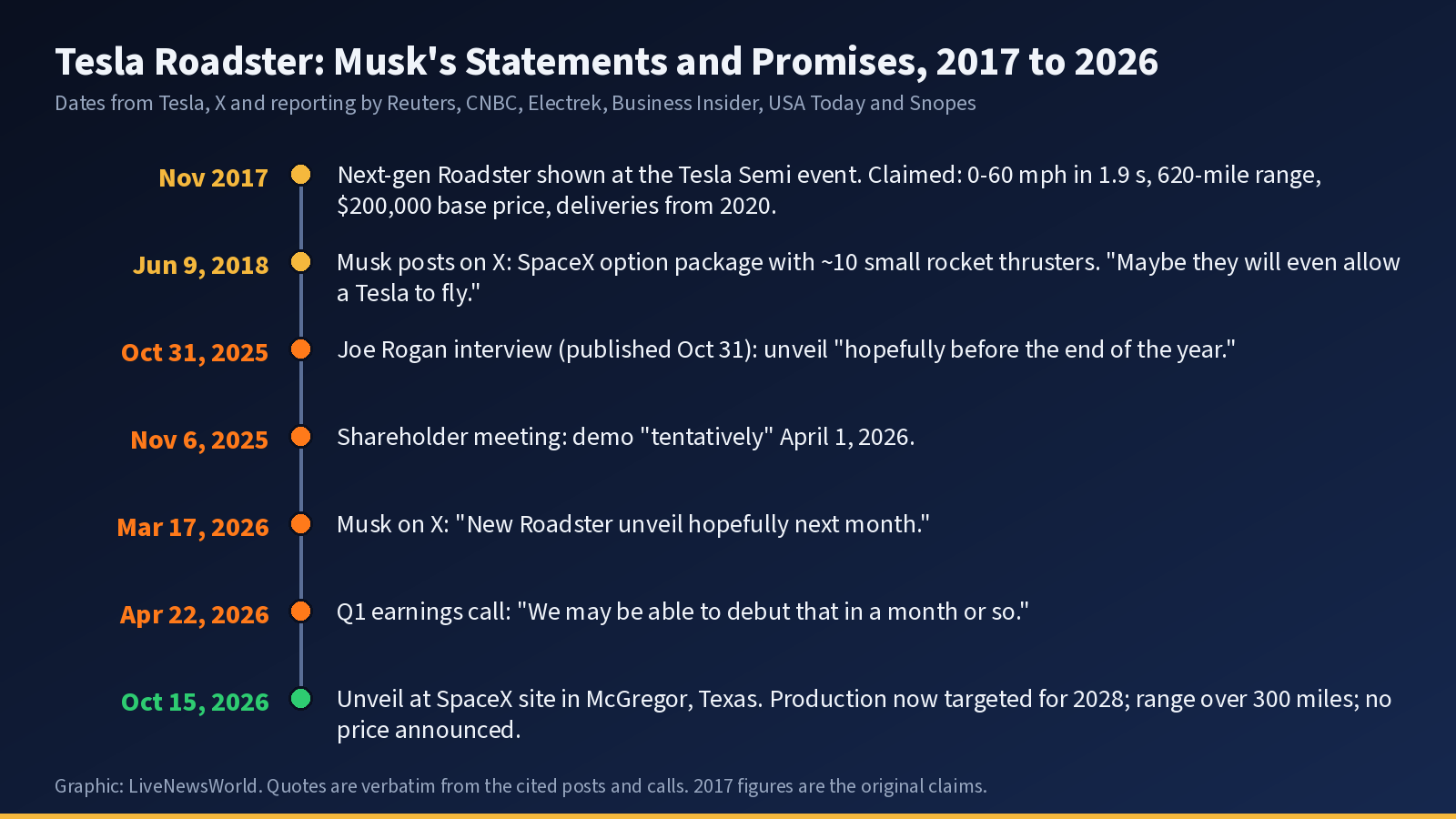
- Tesla promised 2020 deliveries when it first showed the car in 2017, and Musk first floated rocket thrusters for it in June 2018.
The Tesla flying car is, so far, a Roadster prototype that can leave the ground for a few seconds. Nobody can buy it or legally fly it yet. Here is what happened at the Oct. 15 unveil, what Musk and Tesla claim, and what is still unconfirmed.
What happened at the unveil
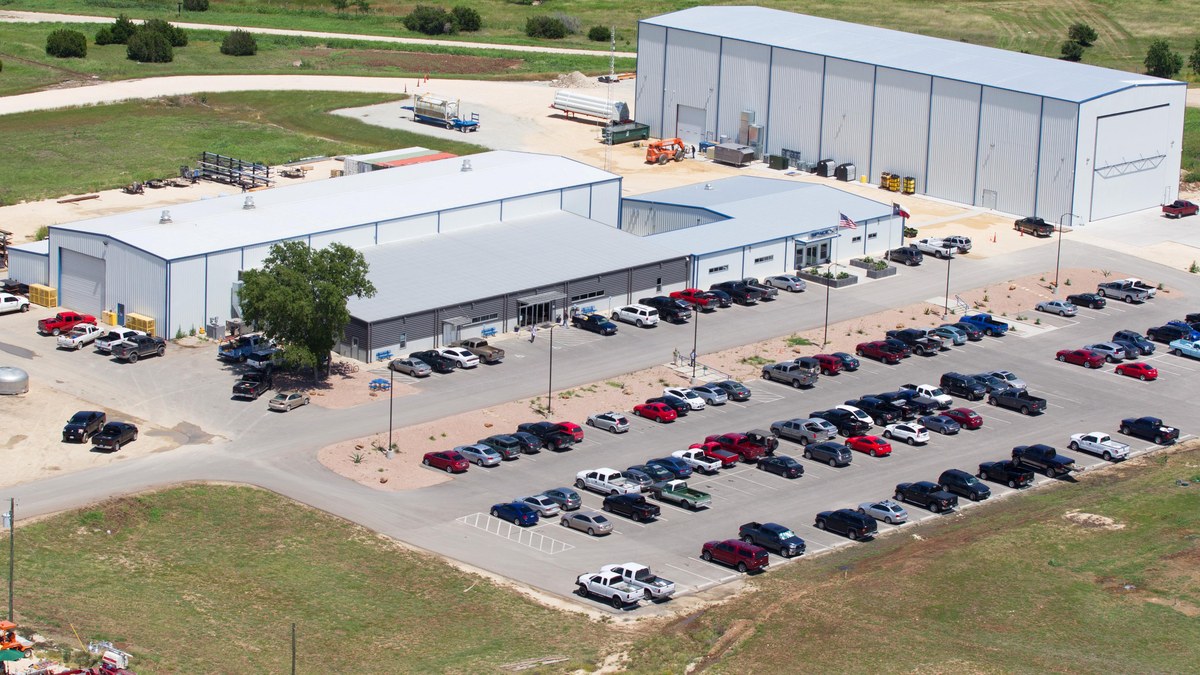
Tesla livestreamed the event from a SpaceX test site in McGregor, near Waco, Texas. It began at 7:55 p.m. local time (8:55 p.m. ET), with Musk, design chief Franz von Holzhausen and vehicle engineering chief Lars Moravy on hand, CNBC reported.
The white prototype first drove up a tall, curved ramp and clung to it upside down, held by a fan-based suction system. It then launched off the edge, rolled in the air and landed on its wheels using thrusters. Later it jumped over a row of other Tesla vehicles, including the Semi truck, in a stunt Tesla calls “the kickflip.” A separate run showed 0-60 mph in 0.81 seconds on Tesla’s timer, The Verge and Road & Track reported.
The demonstrations were real. Snopes rated the footage authentic, noting that attendees filmed their own clips and that Top Gear said its staff watched in person. The prototype carried no one. Musk said that was “to make sure we don’t kill anyone,” Wired reported, and the Guardian said the car was controlled remotely.
What Musk said
On stage, Musk said “Flying cars are real” and that the car “can basically fly like a rocket,” the Guardian and The Verge reported. He said success was not guaranteed but that “it will probably work,” CBS News reported.
He also hedged. “This is not necessarily a safety-optimized car,” he said, and “I’m not sure it’s necessarily legal in all jurisdictions,” Wired reported. At 9:57 p.m. ET, Musk posted a video on X with the caption “Turns out the future does have flying cars.” The Associated Press and the Guardian both quoted the post.
What is verified about the Roadster
Only facts reported by at least two outlets, or stated by Tesla, are listed.
| Item | What is reported | Sources |
|---|---|---|
| Propulsion | Fan-based suction system plus cold-gas thrusters, about 10 nozzles | Tesla, The Verge, Top Gear |
| 0-60 mph | Under 1 second claimed; 0.81 seconds on Tesla’s timer in the demo | CNBC, The Verge, Road & Track |
| Top speed | Over 230 mph, per Moravy; Musk said “much faster than that” | Reuters, Top Gear |
| Range | Over 300 miles, versus 620 miles promised in 2017 | Reuters, The Verge |
| Production | Targeted for 2028 | Reuters, CNBC, AP |
| Trims and amounts | Performance, $50,000; Thrust, $250,000; Rocket, one seat, invite only | Reuters, Washington Post |
| Road status | Rocket “not approved for public road use” | Tesla, Snopes, AP |
| Price | Not announced | CNBC, Reuters, AP |
A decade of Roadster promises
Tesla showed a next-generation version in November 2017 with a claimed 0-60 mph time of 1.9 seconds, a 620-mile range, a $200,000 base price and deliveries from 2020, The Verge and Reuters reported. CNBC says Tesla has missed every date since.
- June 9, 2018: Musk posted on X that a SpaceX option package would add “~10 small rocket thrusters” and “Maybe they will even allow a Tesla to fly.”
- Oct. 31, 2025: In an interview with Joe Rogan, Musk said an unveil could come “hopefully before the end of the year,” CNBC reported.
- Nov. 6, 2025: At the shareholder meeting he said the demo was “tentatively” set for April 1, 2026.
- March 17, 2026: Musk posted on X, “New Roadster unveil hopefully next month.”
- April 22, 2026: On the Q1 earnings call he said, “We may be able to debut that in a month or so.”
- Oct. 15, 2026: The unveil, with production now aimed at 2028.
Is it really a flying car?
Snopes called that “open to interpretation,” since the demos showed short, controlled launches, not sustained flight. Road & Track noted each stunt used only a few seconds of boost.
Regulators have not signed off on anything. The FAA told Wired, “The Tesla vehicle does not meet the FAA’s definition of an aircraft.” NHTSA told CBS News the manufacturer “must ensure that it does not defy applicable Federal Motor Vehicle Safety Standards,” and a senior Transportation Department official said there was no clear answer on who would oversee a flying car.
A former FAA official quoted by Wired said a flying vehicle over about 250 pounds would need FAA approval and predicted certification could take “at least a year.” Road-to-air takeoffs would also fall under state and local rules.
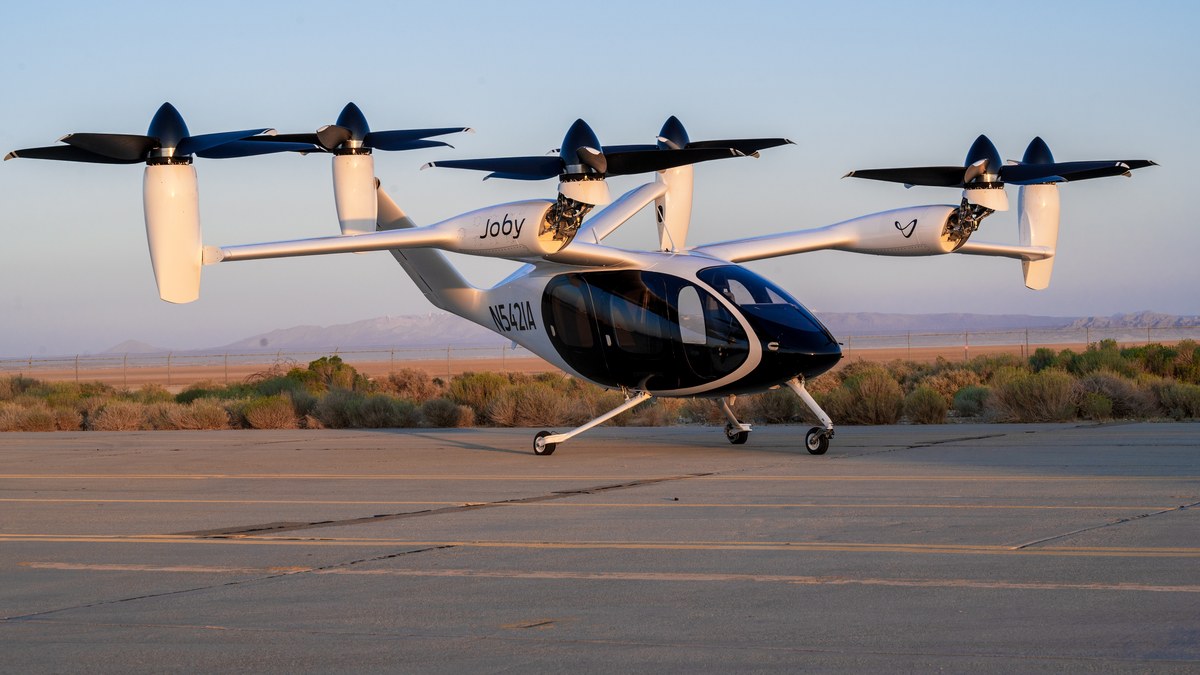
For context, the flying vehicles the FAA is actually certifying are electric vertical takeoff and landing (eVTOL) air taxis. Joby said in its Aug. 5 shareholder letter that it was in the fifth and final stage of FAA type certification and targeted carrying its first passengers in 2026. Wired reported that the Trump administration launched a three-year pilot program this year for such aircraft.
What skeptics say
Tesla investor Gene Munster wrote on X that the event “was an engineering flex with no commercial value beyond embarrassing traditional car makers,” Reuters reported. The Verge called the flying version “just for show.” Top Gear, which attended, said it left “more questions than answers.” Musk himself has called the Roadster a “small potato situation” that will not “move the needle in a major way financially.”
Why it matters for Tesla and investors
Tesla shares rose on Friday, about 5% in premarket trading according to Reuters and about 2% in morning trading according to the Associated Press. CNBC said the Roadster is unlikely to have a material financial impact. Some watchers tied the show to speculation about a Tesla and SpaceX merger, which neither company has announced.
Tesla reports third-quarter results on Wednesday, Oct. 21, after the market close, CNBC reported. Follow the market reaction on our Markets Live page, and see where large-cap tech stands in our Nasdaq-100 outlook.
What to watch next
- Price and specs: Tesla gave no price or full specs for every trim.
- Independent testing: No third party has verified the 0.81-second run.
- Regulation: Whether the FAA, NHTSA or states set rules for the Rocket version.
- Oct. 21 earnings: Whether Tesla updates the 2028 production target.
- 2028 production: Tesla has missed every earlier Roadster date.
Related coverage
For the wider shift toward autonomous transport, read our explainer on future technologies that will change the U.S. by 2030.
Sources
- Tesla, Roadster page (accessed Oct. 17, 2026).
- Elon Musk on X, Oct. 15, 2026 (9:57 p.m. ET) and June 9, 2018.
- Reuters, “Tesla’s new Roadster turns in air with SpaceX thrusters, won’t land until 2028,” Oct. 15, 2026.
- CNBC, “Tesla unveils long-delayed Roadster developed with SpaceX, fueling merger speculation,” Oct. 15, 2026.
- Wired, “A Tesla Flying Car? I Don’t Know, Man,” Oct. 15, 2026, updated Oct. 16.
- Also consulted: The Verge, Road & Track, Snopes, CBS News, the Associated Press, the Guardian, Top Gear, the Washington Post and Joby Aviation’s Q2 2026 shareholder letter.