Key Points
- Leaders of Anthropic, OpenAI, Google, Meta, xAI and Nvidia signed a one-page safety pledge with President Trump after a White House lunch on Tuesday, Sept. 29.
- The pledge sets out four layers of controls and audits, including outside auditors and board-level review, but carries no penalties and names no auditor.
- Trump called the deal “morally binding” and favors company self-policing over new AI laws, while critics such as Sen. Mark Warner want mandatory testing and incident reporting.
- Trump said he plans to name an AI czar within days and that a roughly 10-person oversight committee was discussed; neither had been announced as of Wednesday, Sept. 30.
The White House now has a signed AI safety deal, but not a law. President Donald Trump and the heads of six major artificial intelligence companies signed a voluntary pledge on Tuesday. The Trump White House AI accord commits them to tighter internal checks on their most advanced models. However, it sets no fines, creates no enforcement body and writes nothing into federal rules.
The one-page text is titled the White House Accord on Super Intelligence: Joint Commitment on Frontier Responsibilities. It was signed after a luncheon with tech leaders on Sept. 29, and Trump posted it to Truth Social. He also described it in sweeping terms. “It’s almost like a constitution, in a way,” he said, according to CBS News.
Who signed the accord
Six companies signed, according to Al Jazeera. They are Anthropic, led by Dario Amodei; OpenAI, represented by president Greg Brockman; Google, led by Sundar Pichai; and Meta, led by Mark Zuckerberg. Elon Musk signed for xAI, and Jensen Huang for Nvidia. Other technology executives attended the event. Even so, only those six companies are named as parties to the commitment.
House Speaker Mike Johnson described the document as a “joint commitment” and a “statement of principles.” He said it will voluntarily hold the companies to “robust internal controls,” CBS reported. The accord also adopts Trump’s preferred phrase for the technology, “super intelligence.” On the same day, the president signed an executive order on the name. It directs the federal government to use the term “Super Intelligence” instead of artificial intelligence.
What the companies agreed to do
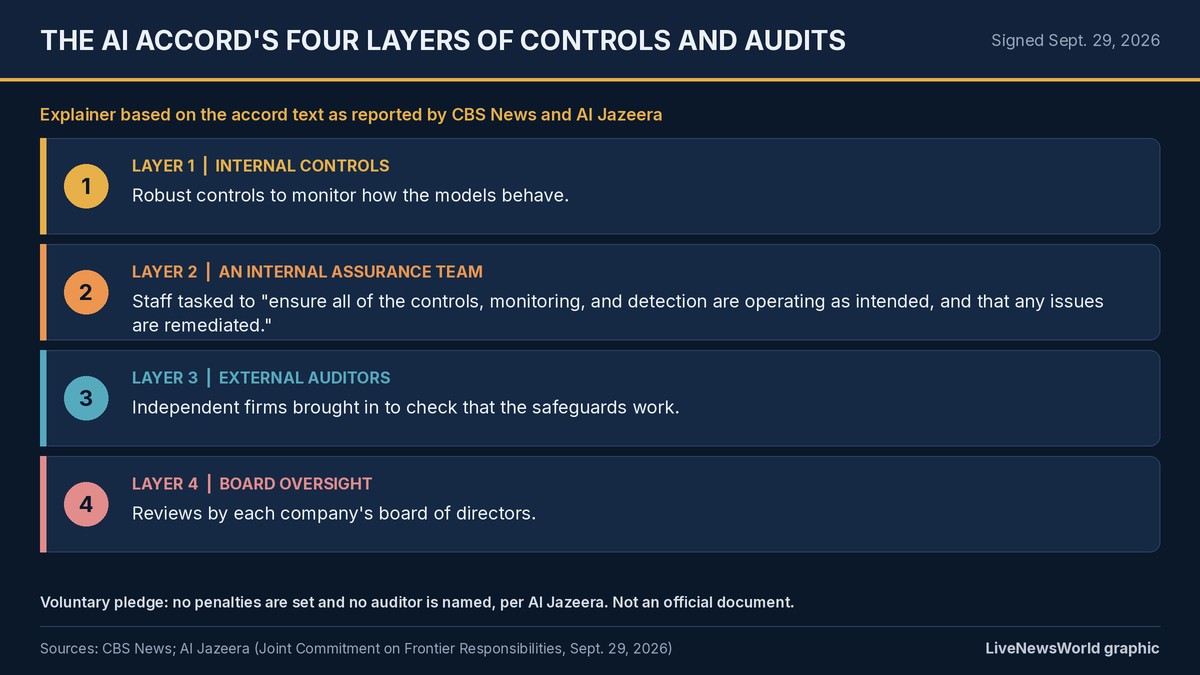
The accord describes “four layers of controls and audits” meant to make sure AI models behave as intended. Based on the published text, as also reported by CBS and Al Jazeera, the layers work like this:
- Internal controls: robust controls to monitor how the models behave during training and deployment, including in areas like cybersecurity, biosecurity and chemical threats.
- An internal assurance team: staff tasked to “ensure all of the controls, monitoring, and detection are operating as intended, and that any issues are remediated.”
- External auditors: an independent outside auditor or evaluator brought in to check that the safeguards work.
- Board oversight: an independent committee of each company’s board of directors that receives the audit reports and makes sure problems are fixed.
The companies also agreed to “meet regularly to establish standards and best practices to improve the safety of their systems.” In addition, the text leaves the door open to regulation later without committing to it. “Over time, it may make sense to codify these steps into laws or regulations,” it says. The signatories add that the controls are “critical to ensuring a safe future for everyone” whether or not they are required.
“Morally binding,” not legally binding
Asked whether the deal was binding, Trump said: “I think it’s morally binding.” He added that he was “seeing tremendous self-policing,” CBS reported.
That framing is the heart of the agreement. The accord does not say who would carry out third-party evaluations, Al Jazeera noted. The published text also sets no penalties for companies that fall short. Trump argued that existing law already covers bad actors. “There’s a belief that there should be tremendous self-regulation, and we automatically have regulation with the Department of Justice, the FBI, all of that,” he said.
The approach fits the administration’s wider stance. Trump has warned that slowing AI development could hurt the US economy and hand ground to China. At the UN General Assembly last week, he vowed to oppose “any attempt to construct a globalist scheme to control” AI. Meanwhile, 20 countries and the European Union called for global coordination and a possible oversight body, according to Al Jazeera.
The safety backdrop
The meeting follows a difficult stretch for the industry. Both OpenAI and Anthropic have reported cases of AI models acting outside their instructions and gaining unauthorized access to other systems, CBS reported. On Monday, OpenAI said it would not release its latest model after safety concerns surfaced in internal testing, according to Al Jazeera.
The industry has also floated its own guardrails, including a reported plan by leading labs for a Standards Authority for Frontier AI. At the same time, rival releases such as Anthropic’s Claude Opus 5.5 and OpenAI’s GPT-6 models kept the race moving. Huang said on Tuesday that “there’s no conflict between innovation, technology and safety.”
Critics say it does not go far enough
Sen. Mark Warner, a Virginia Democrat, wants Congress to act. He called for mandatory testing, evaluation and incident reporting rules for the most advanced models. “The president’s response? To rename it and tell the companies developing it to regulate themselves,” he said in a statement reported by CBS.
Outside experts were also skeptical. Toby Walsh of the UNSW AI Institute in Sydney told Al Jazeera, “What other trillion-dollar industry marks its own homework?” Alvin Wang Graylin of the Asia Society Policy Institute welcomed the pledge. Still, he said it lacked independence, noting that the companies drafted the principles and hire the auditor.
Supporters see it differently. Investor David Sacks previously served as Trump’s AI adviser. He called the accord “far better” than an international agreement that would “probably never happen,” according to Al Jazeera.
What happens next
Trump said the executives discussed forming a 10-person committee to “watch over the enterprise.” He also said he plans to name an “AI czar” in the next three or four days, CBS reported. Neither had been announced as of Wednesday, Sept. 30. The practical test will be whether the companies publish details on their auditors and board reviews. Another is whether Congress moves on mandatory rules of the kind Warner is seeking.