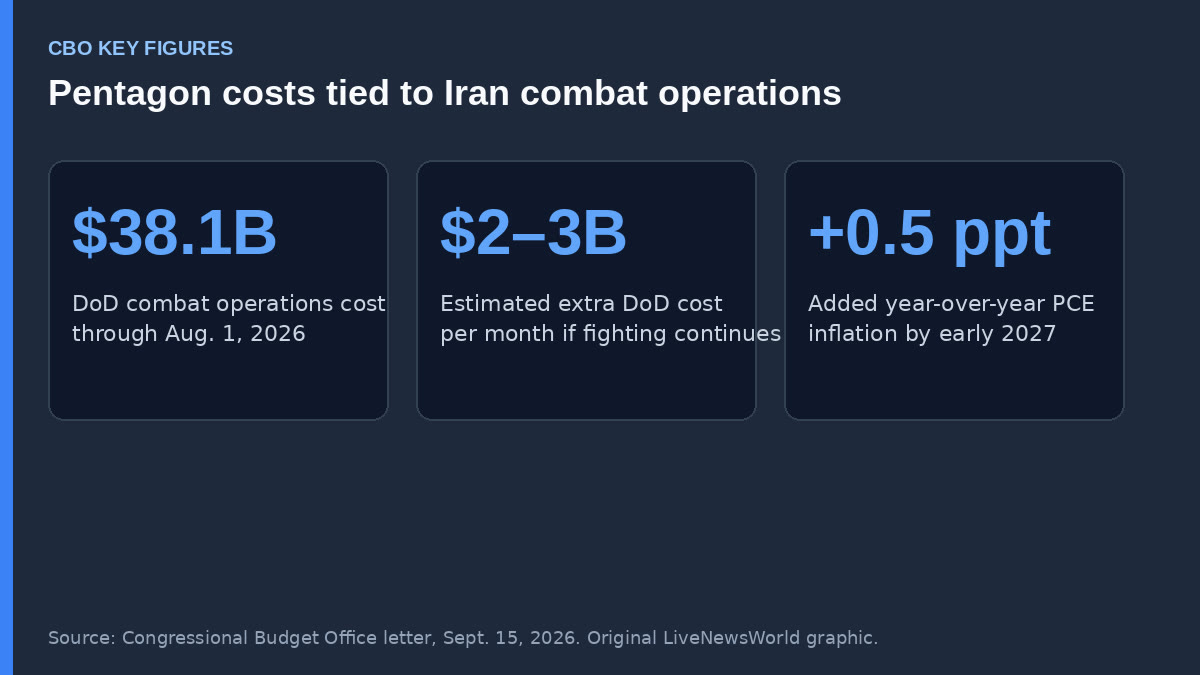
Seven weeks before the midterms, Washington has a new benchmark for the price of the war with Iran. The Congressional Budget Office says U.S. combat operations have cost the Pentagon about $38 billion as of Aug. 1, 2026, or roughly $38.1 billion in the agency’s detailed accounting.
The Sept. 15 analysis, signed by CBO Director Phillip L. Swagel and prepared at the request of Rep. Brendan Boyle of Pennsylvania, is a nonpartisan attempt to put dollars, inflation pressure, and munitions exhaustion on the same page. For readers who tracked earlier Pentagon briefings, the headline number will feel familiar. The letter’s value is in what it separates: what DoD has already spent, what each additional month may cost, and how long it could take to refill missile-defense stocks.
The full letter is available via a Senate-hosted copy of the CBO analysis, with the agency PDF on cbo.gov as the preferred primary link.
Key numbers from the CBO letter
| Measure | CBO figure |
|---|---|
| DoD combat ops cost through Aug. 1, 2026 | About $38.1 billion |
| Munitions replacement | About $21.7 billion |
| Increased flying hours | About $10.4 billion |
| Higher fuel costs (FY2026 accounting) | About $2.7 billion |
| Extra monthly cost if war continues | About $2-3 billion (intensity-dependent) |
| PCE inflation effect by Q1 2027 | About +0.5 percentage points year over year |
| Core PCE inflation effect | About +0.3 percentage points |
| Missile-defense interceptors used since June 2025 | About one-half to two-thirds of inventory (CBO assessment) |
| Time to rebuild interceptor stocks | At least five years, even with higher production |
Timeline
| Date | Development |
|---|---|
| June 2025 | Twelve-Day War period referenced in CBO interceptor inventory discussion |
| Feb. 28, 2026 | Operation Epic Fury begins (U.S. and coordinated Israeli strikes, per CBO) |
| April 8, 2026 | U.S.-Iran ceasefire begins; intensity later eases, then fluctuates |
| June 29, 2026 | DoD Inspector General checkpoint cited in secondary reporting (about $33.4 billion) |
| July 22, 2026 | Defense Secretary Pete Hegseth cites about $37.5 billion ops cost (per CBO comparison) |
| Aug. 1, 2026 | Cutoff date for CBO’s about $38.1 billion DoD cost estimate |
| Sept. 15, 2026 | CBO letter to Rep. Brendan Boyle released |
Inside the $38 billion estimate
CBO ties the figure to Operation Epic Fury, the conflict that began on Feb. 28, 2026. The estimate covers replacing expended munitions and some battle-lost equipment, higher flying hours, other operations costs, and elevated fuel costs.
Munitions dominate the ledger. Replacing weapons used through Aug. 1 accounts for about $21.7 billion, including land-attack cruise missiles and missile-defense interceptors such as Patriot, THAAD, SM-3, and SM-6 rounds. Increased flying hours add about $10.4 billion. Higher fuel costs contribute about $2.7 billion in CBO’s fiscal year 2026 accounting, combining surcharges paid by the military services and losses reported in the Defense Logistics Agency’s fuel business.
Smaller lines cover equipment CBO judges DoD would need to replace after battle losses, plus “other operations” costs for ships, ground units, and related special pays. The agency stresses that its work on operations, opportunity costs, and economic effects are separate analyses with different methods and uncertainty. They are not meant to be added into one all-purpose war bill.
Just as important is what is missing. CBO excludes costs borne by other parts of the federal government and peacetime operating costs already in the defense budget. It also could not price repairing or rebuilding damaged U.S. bases. The Pentagon, the letter says, did not supply the information needed for that category.
The meter is still running
If the war continues, CBO estimates each additional month could cost DoD roughly $2 billion when violence stays relatively low, or about $3 billion when intensity rises toward levels seen in July 2026. Spikes in expensive munitions use, or a sharper escalation, could push monthly costs higher still.
That range tracks the conflict’s uneven pace. CBO notes an intense opening phase lasting just over a month, a ceasefire that began April 8, 2026, a later presidential declaration that the ceasefire was over after tanker attacks in the Strait of Hormuz, and stretches of lower but continuing violence. The burn rate rises and falls with intensity.
Inflation travels through the Strait
Beyond the Pentagon’s books, CBO points to energy markets as the main channel into the broader economy. Reduced oil and gas shipments through the Strait of Hormuz, plus disruptions to Red Sea shipping, have lifted global energy prices and the cost of moving goods.

In the agency’s assessment, those pressures leave year-over-year personal consumption expenditures (PCE) inflation about 0.5 percentage points higher by the first quarter of 2027 than CBO projected in February 2026. Core PCE inflation, which excludes food and energy, is estimated about 0.3 percentage points higher than previously projected.
CBO also describes modest, roughly offsetting effects on the federal budget from higher inflation and interest rates: more revenue on one side, higher interest and inflation-linked spending on the other. Those fiscal ripples are not folded into the $38 billion DoD operations total. For earlier LiveNewsWorld coverage of broader economic effects, see the economic impact of the U.S.-Iran war.
Interceptors used today, shortages tomorrow
The letter’s sharpest strategic warning sits outside the sticker price. Comparing public reports of interceptor use with purchase histories, CBO says the United States has probably used between about one-half and two-thirds of its key missile-defense interceptors since June 2025, including rounds used while defending Israel and munitions expended in Operation Epic Fury.
Rebuilding those stocks would probably take at least five years even if production rises, CBO says, citing historically slow scale-up for complex interceptors. A thinner inventory would matter more against an adversary with large ballistic and cruise missile arsenals. The cost of this war is not only measured in dollars already spent.
How $38 billion sits beside earlier tallies
CBO’s estimate lands close to a figure Defense Secretary Pete Hegseth cited in July 2026 testimony: about $37.5 billion for combat operations costs through September 2026, according to the letter’s comparison section. An earlier Department of Defense Inspector General checkpoint, cited in secondary reporting, put related costs around $33.4 billion as of June 29. That earlier snapshot is not a substitute for CBO’s August update.
That update is higher than earlier LiveNewsWorld reporting on Pentagon cost disclosures, including an estimate that the U.S. war in Iran had cost about $25 billion so far and later coverage asking whether the conflict was costing Americans about $29 billion or far more.
The Administration’s supplemental request is a different animal. It mixes conflict-related needs with other priorities. When CBO isolates request lines that appear directly related to the conflict, that subset totals about $42.3 billion, near the agency’s own estimate, though the definitions are not identical. Secondary reporting on the letter includes coverage from CNBC, ABC News, and The Guardian.
What CBO will not pretend to know
Uncertainty is part of the product. Because DoD did not respond to CBO’s information requests, estimators relied on government databases and public reporting. Base repair costs remain unpriced. The letter assigns no dollar figure to personnel killed or wounded, or to longer-term veterans’ care. The $38 billion figure is substantial. It is also incomplete, and CBO says so.
Why the letter lands now
Congress has still not fully enacted dedicated war funding. Midterms arrive on Nov. 3, 2026. A nonpartisan score of munitions burn, monthly operating costs, consumer-price pressure, and multi-year stockpile recovery will not end the political argument over the war, but it does give lawmakers and voters a shared baseline.
What to watch next
If combat intensity stays low, CBO’s framework points to roughly $2 billion more per month for DoD. Sharper fighting pushes that toward $3 billion or higher. Replenishing missile-defense interceptors remains a multi-year industrial problem under CBO’s reading of production history.