Key Points
- Quantitative easing is the Federal Reserve buying longer-term Treasuries and agency mortgage-backed securities at scale to ease financial conditions when the policy rate is already near zero or when markets need large support.
- U.S. QE came in distinct rounds: LSAP1 (2008-2010), LSAP2 (2010-2011), LSAP3 (2012-2014), and the COVID large-scale asset purchases that began in March 2020 (New York Fed LSAP archive; Fed balance-sheet timeline).
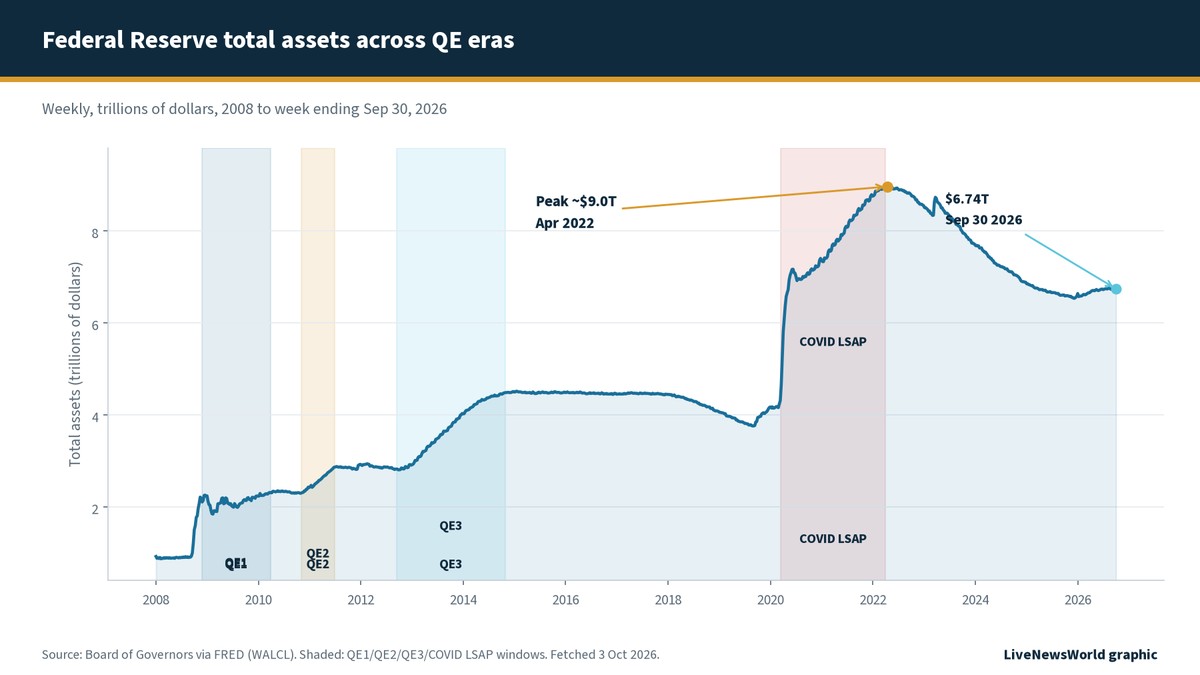
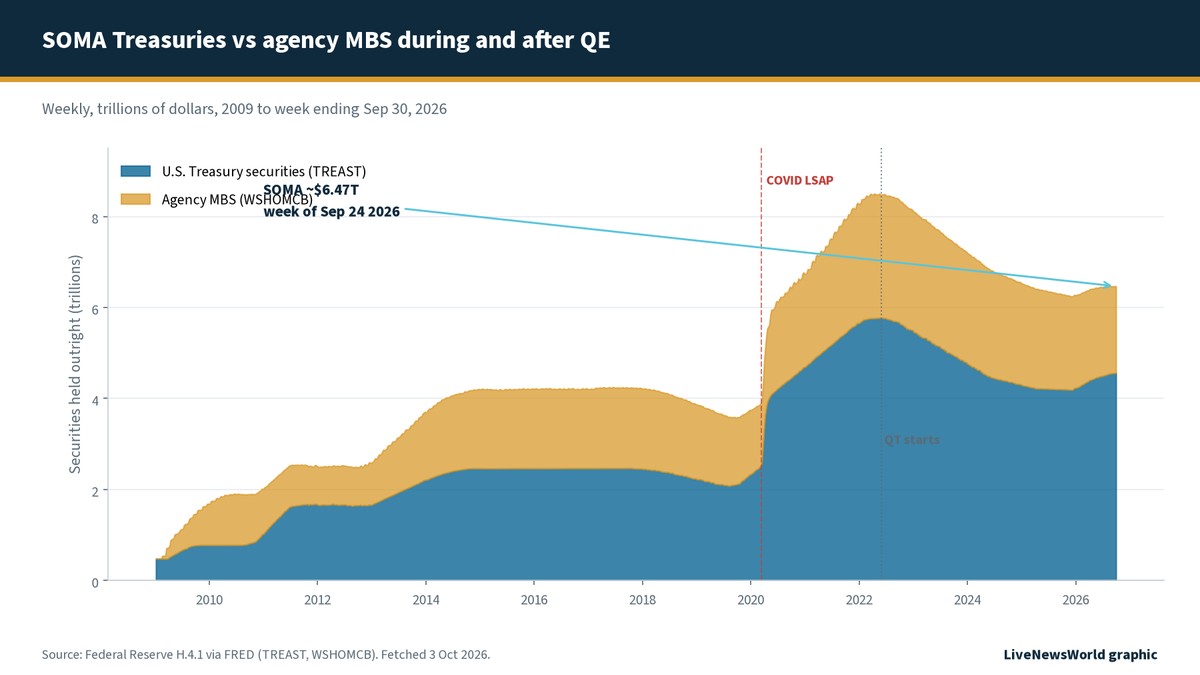
- As of the H.4.1 week ending September 30, 2026, Federal Reserve total assets were about $6.74 trillion and SOMA Treasuries plus agency MBS were about $6.46 trillion (FRED WALCL, TREAST, WSHOMCB).
- QE is not the same as cutting the federal funds rate, and it is the opposite direction of quantitative tightening, which ran until runoff ended on December 1, 2025.
Quantitative easing is the Federal Reserve’s large-scale purchase of longer-term securities, mainly U.S. Treasuries and agency mortgage-backed securities, to put downward pressure on longer-term yields and ease broader financial conditions. In plain terms, when ordinary rate cuts are not enough (or the overnight policy rate is already near zero), the Fed can still ease by expanding the securities it holds in the System Open Market Account and the bank reserves that come with those purchases.
This explainer defines how quantitative easing works, how it differs from the federal funds rate and from quantitative tightening, what the historical U.S. QE rounds looked like, and how markets usually read the tool. For institutional context, see LiveNewsWorld on what the U.S. Federal Reserve is.
What is quantitative easing?
Quantitative easing (QE), often labeled large-scale asset purchases (LSAPs) in Federal Reserve materials, is a balance-sheet policy. The New York Fed’s Desk buys longer-term securities in the open market. Those purchases credit reserve balances to banks and remove duration from private hands. The intended channels are lower longer-term interest rates, support for mortgage and credit markets, and more accommodative financial conditions overall.
QE is not “printing cash for households.” Mechanically, the Fed exchanges newly created reserves for securities. Whether that eases conditions depends on the size and composition of purchases, market functioning, and how investors update expectations for inflation and future policy rates.
Modern U.S. QE focused on Treasuries, agency debt, and agency MBS. The FOMC set the goals and sizes; the New York Fed Desk executed the operations.
Quantitative easing vs rate policy vs quantitative tightening
Three tools get mixed up in headlines. Rate policy sets the overnight federal funds target range. QE grows the securities portfolio. Quantitative tightening shrinks it, mainly through capped runoff. They can move in the same cycle, but they are different dials.
| Feature | Federal funds rate policy | Quantitative easing (QE) | Quantitative tightening (QT) |
|---|---|---|---|
| What moves | Overnight policy-rate target range | Stock of SOMA securities and reserves | Stock of SOMA securities and reserves |
| Typical method | IOER/IORB, ON RRP, and related administered rates | Large-scale purchases of Treasuries and agency MBS | Capped runoff of maturities and MBS paydowns |
| Balance-sheet direction | Not the primary lever | Grows holdings | Shrinks holdings (or stops growth) |
| When often used | Ordinary cycles away from the effective lower bound | Near the lower bound, or when markets need large support | After QE, when the FOMC wants to normalize the portfolio |
| Not the same as | Buying bonds for stimulus | A cut in the federal funds rate | A hike in the federal funds rate |
Conceptual comparison based on Federal Reserve Policy Normalization materials, the Fed balance-sheet timeline, and the New York Fed LSAP archive. Fetched 3 Oct 2026.
Historical U.S. QE rounds
The New York Fed archives three post-crisis LSAP rounds plus the maturity extension program, and the Fed’s balance-sheet timeline lists the announcement dates. The COVID response added another large purchase wave in 2020.
| Program | Key dates | What the Fed purchased (official framing) |
|---|---|---|
| QE1 / LSAP1 | Announced Nov 25, 2008; expanded Mar 18, 2009; purchase phase ended March 2010 | $175 billion agency debt, $1.25 trillion agency MBS, $300 billion longer-term Treasuries (NY Fed) |
| QE2 / LSAP2 | Announced Nov 3, 2010; completed by end-June 2011 | $600 billion longer-term Treasuries, about $75 billion per month (NY Fed / Fed timeline) |
| QE3 / LSAP3 | Announced Sep 13, 2012; concluded Oct 2014 | Open-ended then tapered purchases; totals $790 billion Treasuries and $823 billion agency MBS (NY Fed) |
| COVID LSAP | Mar 15, 2020 floors; Mar 23, 2020 “amounts needed” | At least $500 billion Treasuries and $200 billion agency MBS, then purchases in the amounts needed for market functioning (FOMC statements) |
Sources: New York Fed Large-Scale Asset Purchases archive; Federal Reserve timeline of balance-sheet policies; FOMC statements of March 15 and March 23, 2020. Fetched 3 Oct 2026.
Between purchase programs, the FOMC often kept the portfolio large by reinvesting principal. That stock effect matters: ending new purchases is not the same as shrinking the balance sheet.
What the latest balance-sheet numbers show
QE leaves a footprint that lasts long after the last purchase. As of early October 2026, the latest complete weekly H.4.1 observations in FRED run through the week ending September 30, 2026. Total Federal Reserve assets (WALCL) were about $6.74 trillion. Securities held outright (TREAST plus WSHOMCB) were about $6.46 trillion that week, and about $6.47 trillion for the week ending September 23, 2026. Reserve balances (WRESBAL) were about $2.95 trillion on September 30.
Those levels sit well below the April 2022 peak near $8.97 trillion in total assets, after the 2022-2025 QT runoff that ended on December 1, 2025 (Fed Policy Normalization page). LiveNewsWorld’s sister explainer on quantitative tightening covers that runoff phase in detail.
| Milestone (nearest weekly date) | Total assets (WALCL) | SOMA Treasuries + MBS |
|---|---|---|
| Sep 10, 2008 (pre-crisis week) | $0.93 trillion | n/a in this table focus |
| Oct 29, 2014 (near QE3 end) | $4.49 trillion | see stacked chart |
| Mar 11, 2020 (pre-COVID LSAP surge) | $4.31 trillion | see stacked chart |
| Apr 13, 2022 (near QE peak) | $8.97 trillion | $8.50 trillion |
| Dec 3, 2025 (near QT runoff end) | $6.54 trillion | $6.24 trillion |
| Sep 30, 2026 (latest week) | $6.74 trillion | $6.46 trillion |
Source: Federal Reserve H.4.1 via FRED (WALCL, TREAST, WSHOMCB). SOMA column is TREAST plus WSHOMCB where shown. Figures rounded. Fetched 3 Oct 2026.
How quantitative easing affects markets
The textbook channel is duration extraction. When the Fed buys longer-term Treasuries and agency MBS, private investors must hold other assets or accept lower yields on safe duration. That can pull down longer-term rates relative to a no-QE path and encourage portfolio rebalancing into riskier credit and equities. The size of the effect is debated, and growth, inflation, and rate-path expectations often dominate week-to-week moves.
Reserves are the other ledger entry. QE adds bank reserves. In today’s ample-reserves framework, that stock supports smooth overnight rate control when it is large enough. Too little can show up as money-market volatility; that is one reason QT was designed to stop before reserves became scarce.
For households, QE rarely appears as a named line item. It shows up indirectly through mortgage-backed markets, Treasury yields, and risk appetite. LiveNewsWorld’s explainer on the inverted yield curve covers a related bond-market signal. Inflation context sits in core inflation.
How to read a QE announcement without overreacting
Start with the FOMC’s own language: size, pace, composition (Treasuries versus agency MBS), and whether purchases are open-ended or capped. Announcement effects often hit yields and risk assets before the first operation settles, because markets price the expected stock of purchases, not only the first week’s flow.
Next, separate market-functioning purchases from broader accommodation. The March 2020 statements explicitly prioritized smooth functioning in Treasury and agency MBS markets. Later COVID-era purchases also supported transmission of policy to broader conditions. Those motives can overlap in the same week, which is why reading only the headline “Fed buys bonds” loses information.
Finally, watch the exit language as carefully as the entry. Tapering the pace, ending purchases while reinvesting, and starting QT are three different regimes. Confusing them produces wrong balance-sheet stories. The Fed’s Policy Normalization materials and H.4.1 data remain the cleanest official scoreboard once the press conference ends.
Common misconceptions about quantitative easing
“QE is just another name for cutting interest rates.” No. Cutting the federal funds rate changes overnight administered rates. QE changes the stock of securities and reserves. They often appear together near the effective lower bound, but they are different tools.
“QE always causes runaway consumer inflation.” Large balance-sheet expansions can ease financial conditions and, in some settings, contribute to higher inflation pressure. Outcomes still depend on demand, supply shocks, fiscal policy, and expectations. Post-crisis U.S. inflation stayed low for years after QE1-QE3; the COVID period mixed huge purchases with an unprecedented real-economy shock.
“When the Fed stops buying, the balance sheet instantly shrinks.” Stopping purchases leaves the existing stock in place unless the Fed also stops reinvesting or runs a QT program. Stock and flow are different.
“Every Fed bill purchase is QE.” After QT ended in December 2025, the Desk used reserve management purchases of bills at times to keep reserves ample. Those operations share a purchase mechanic with QE but are framed as technical reserve management, not a return to crisis-era stimulus messaging.
Video: quantitative easing explained
The Plain Bagel’s explainer walks through what quantitative easing is and how it differs from ordinary open-market operations aimed only at the overnight rate. Preview the embed before relying on it in a live post.
Video: “What is Quantitative Easing?,” The Plain Bagel. Title and publisher verified via YouTube oEmbed on 3 Oct 2026.
Frequently asked questions
Is the Fed doing quantitative easing right now?
As of early October 2026, the U.S. is not running a named QE purchase program like QE1-QE3 or the 2020 COVID LSAP wave. The 2022-2025 QT runoff ended on December 1, 2025. Occasional reserve management purchases of Treasury bills, when used, are communicated as tools to keep reserves ample, not as a new LSAP stimulus program.
Does quantitative easing lower mortgage rates by itself?
QE that includes agency MBS can support mortgage markets by adding a large buyer of mortgage duration. Mortgage rates still depend heavily on longer-term Treasury yields, credit spreads, and expectations for the federal funds rate. Treat QE as one background factor, not the sole driver of any week’s mortgage quote.
Where can I track the Fed’s securities holdings?
The Federal Reserve’s weekly H.4.1 release is the official scoreboard. FRED republishes the main lines, including total assets (WALCL), Treasury holdings (TREAST), and agency MBS holdings (WSHOMCB). The New York Fed LSAP archive summarizes the historical purchase programs.
The bottom line
Quantitative easing is large-scale Federal Reserve buying of longer-term Treasuries and agency MBS to ease financial conditions beyond what overnight rate policy alone can do. The United States used it in clear rounds after 2008 and again in the COVID market-stress period. QE grows the balance sheet; quantitative tightening shrinks it; the federal funds rate remains the primary day-to-day policy dial. Read QE as a balance-sheet chapter with official dates and sizes, not as a synonym for every form of monetary ease.